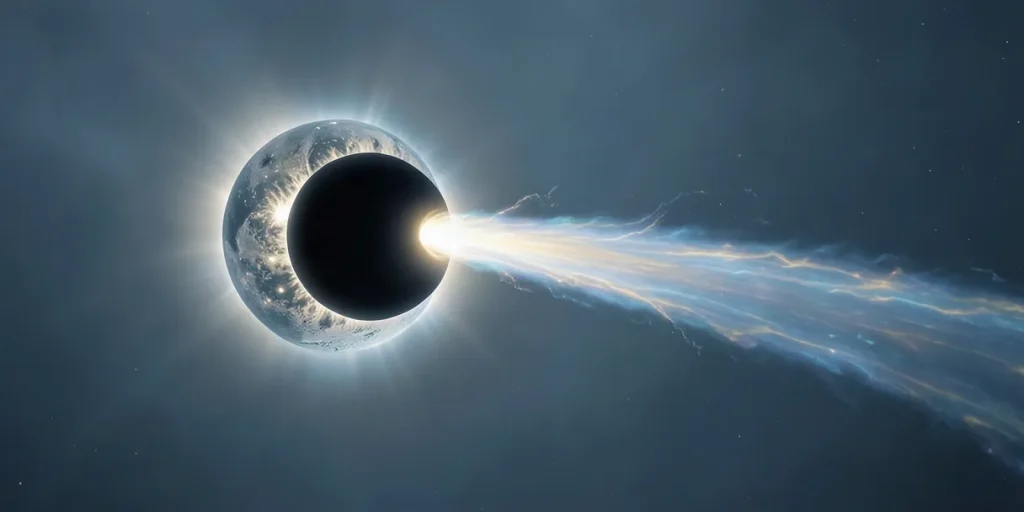
On October 31, Earth entered a stream of solar plasma from a coronal hole, the press service of the Solar Astronomy Laboratory at the Space Research Institute of the Russian Academy of Sciences reported. Plasma temperatures near the planet rose from about 30,000 to 200,000 degrees; moderate geomagnetic disturbances are forecast for the coming days, but no geomagnetic storms are expected.
What is happening near Earth
The planet is passing through a region of disturbed space where solar-wind parameters are rising. Laboratory specialists described the situation this way in a post published on their Telegram channel. The increase in plasma temperature is one of the observed signs that the stream is passing by.
The stream is associated with a coronal hole—a large region on the Sun that, scientists estimate, will continue to affect space weather for another two to three days. The forecast of moderate geomagnetic disturbances applies to October 31 and November 1. However, the likelihood of geomagnetic storms in the near future has been ruled out.
What to expect from geomagnetic conditions
Moderate disturbances and a geomagnetic storm are not the same thing. The laboratory’s report forecasts the former and rules out the likelihood of the latter in the near future. So the fact that Earth has entered the stream does not mean that a geomagnetic storm has already begun or is certain to begin.
Solar flare activity also remains low: at the time of the report, it was at zero. This is a separate measure of solar activity; the current stream, meanwhile, is linked to the coronal hole and changes in the solar wind around Earth.
Coronal holes and solar plasma
A coronal hole is a region of the Sun’s atmosphere from which streams of solar wind flow. When such a stream reaches Earth, it changes conditions in near-Earth space and may be accompanied by geomagnetic disturbances. In this case, the laboratory notes an increase in solar-wind parameters and a substantial rise in plasma temperatures near the planet.
The size of the coronal hole affects the forecast: scientists consider it large and expect it to remain relevant to space weather for the next two to three days. However, estimates of specific effects are limited: for October 31 and November 1, the forecast calls for moderate disturbances, not a geomagnetic storm.
Separate report on a plasma cloud
On October 29, the Space Research Institute of the Russian Academy of Sciences reported that a plasma cloud about 500,000 kilometers across had separated from the Sun. Scientists then assessed that the event would not cause any noticeable disturbances in Earth’s magnetic field. The cloud was associated with a prominence—a large formation of plasma in the Sun’s atmosphere held in place by the star’s magnetic field.
This report concerns a separate event and does not change the wording of the forecast for the stream from the coronal hole. The near-term outlook remains for moderate geomagnetic disturbances on October 31 and November 1; the coronal hole is expected to have an influence for another two to three days.
Sources
- lenta.ru — “Solar plasma stream reaches Earth ahead of schedule”
- news.mail.ru — “The Sun is breathing down our necks. What does this mean for Earth?”
- snob.ru — “Coronal holes: what they are and how they affect Earth”