Updated: August 27, 2026
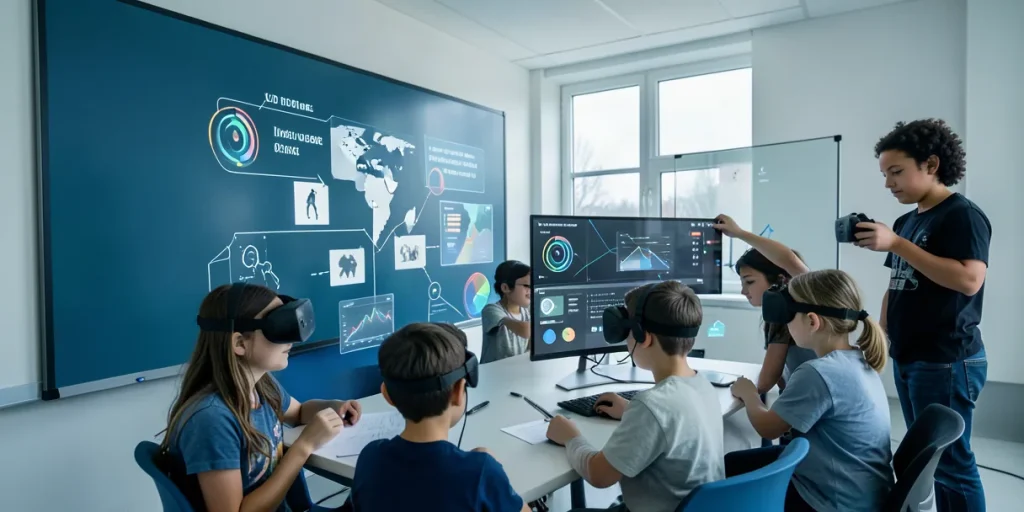
Modern technologies are rapidly penetrating all areas of our lives, and education is no exception. Virtual reality (VR) opens new horizons for teaching children, offering unique opportunities that could not be accessed through traditional methods. How exactly does virtual reality change the approach to teaching children, and what advantages does it bring to the educational process?
Virtual reality allows the creation of interactive and engaging educational environments where children can immerse themselves in the material being studied. Instead of simply reading about scientific concepts or historical events, they can «visit» ancient civilizations or conduct experiments in virtual laboratories. This approach not only increases student motivation but also promotes deeper information retention. In this article, we will examine how technologies in education, especially VR, are transforming traditional learning and what prospects are opening for future generations.
Introduction to Virtual Reality in Education
Virtual reality (VR) is a technology that creates an artificial environment that allows the user to immerse themselves in an interactive experience that simulates reality. In recent years, VR has been actively developing and finding applications in various fields, including education. This technology has ceased to be merely a fantasy and is now actively used in educational institutions around the world. With high-quality visualization and interactivity, VR is becoming an indispensable tool in teaching, transforming traditional methods into more engaging and effective ones.
The popularity of virtual reality in educational institutions can be explained by several factors. First, VR offers unique opportunities for student engagement, allowing them not just to listen to lectures or read textbooks but to actively participate in the learning process. Second, with the help of virtual reality, abstract and complex topics become more understandable and accessible. For example, students can «visit» ancient civilizations, study the structure of molecules, or even conduct virtual experiments in a safe environment. This contributes to better material retention and increases interest in learning.
Among the main advantages of using VR in education, the following can be highlighted:
- Increased engagement: Students become active participants in the process, which enhances their motivation.
- Better information retention: The interactive experience helps consolidate knowledge, as information is perceived through practical interaction.
- Development of critical and creative thinking: Problem-solving in a virtual environment promotes the development of analytical skills.
- Safety: VR allows modeling dangerous or complex situations without risk to health or life.
Thus, virtual reality represents a powerful tool that fosters revolutionary changes in the educational process. It not only makes learning more exciting but also helps develop important skills that will be useful to students in the future.
Student Engagement and Motivation
Virtual reality (VR) opens new horizons in the educational process, transforming abstract concepts into interactive and exciting experiences. Instead of simply reading about physical phenomena or historical events, students can immerse themselves in a virtual world where they become participants in the events. For example, while studying the structure of an atom, children can «move inside» the atom and see its components in action, which helps them better understand the material. This approach not only makes learning more enjoyable but also significantly increases information retention.
Examples of successful VR implementation in education are numerous. Some schools are implementing programs that allow students to study biology by observing the lives of animals in their natural habitats. Children can «visit» tropical forests or ocean depths, helping them better understand ecosystems and the interconnections between living beings. In other cases, VR is used to simulate historical events where students can «be present» at key moments in history, such as on battlefields or in ancient cities. Such practical experiences greatly enhance interest in learning and contribute to a deep understanding of the subject.
Moreover, VR fosters the development of creative and critical thinking among students. Immersion in virtual reality provides the opportunity not only to observe but also to interact with objects and situations. This creates conditions for problem-solving and decision-making in a safe environment, which is crucial for developing the skills needed in real life. Students can develop their own projects and scenarios, stimulating their imagination and innovative thinking.
Thus, virtual reality technologies not only complement traditional teaching methods but also radically change the approach to the educational process, enhancing student engagement and motivation. This makes learning more interactive and exciting, as well as helps children develop essential skills for the future.
Development of Critical and Creative Thinking
Virtual reality (VR) opens new horizons for developing creativity in children, turning education into an exciting and interactive adventure. With the help of VR technology, children can immerse themselves in worlds that previously existed only in their imaginations. This not only activates their imagination but also creates unique conditions for self-expression. For example, in educational scenarios, children can become architects, designing their own buildings, or scientists conducting experiments in a virtual laboratory. This approach stimulates their creative thinking and allows them to explore various scenarios and outcomes of their actions.
Furthermore, VR provides opportunities for developing scenarios aimed at enhancing critical thinking. With virtual reality technologies, problematic situations can be simulated where children must make decisions and analyze the consequences of their actions. For example, in a virtual environment, they may face tasks requiring logical thinking and risk assessment, which contributes to the formation of critical evaluation skills and informed decision-making. This is especially important in a rapidly changing world where the ability to analyze situations and find optimal solutions becomes a key skill.
The impact of VR on problem-solving and decision-making is not limited to creating interactive scenarios. Virtual reality allows children to work in teams, developing collaboration and communication skills. Working together on projects in a VR environment helps children learn from each other, exchange ideas, and create more complex solutions. Thus, virtual reality technologies actively promote both individual and collective learning, which in turn enhances the overall educational environment.
In summary, the introduction of virtual reality into the educational process opens up numerous opportunities for the development of both creative and critical thinking in children, making learning more effective and engaging.
Application of VR in Various Subjects
Virtual reality (VR) is actively being integrated into the educational process, and its application in various subjects demonstrates significant advantages. In the natural sciences, VR allows students to immerse themselves in complex concepts such as cell structure or physical phenomena. For example, students can explore the micro-world by interacting with cells or molecules, making abstract concepts more visual and understandable. This not only improves material retention but also promotes critical thinking development, as students can conduct virtual experiments and observe the results of their actions. In mathematics, VR helps visualize complex problems, turning them into interactive games, making learning more enjoyable and accessible.
In the humanities, the use of VR opens new horizons for studying history, culture, and art. With the help of virtual reality, students can «visit» historical places, experiencing the atmosphere of different eras. This creates a unique opportunity for a deep understanding of the context of events and cultural features. For example, students can «attend» significant historical events or explore works of art in an interactive format. This approach not only increases engagement but also fosters an emotional connection with the material being studied.
The application of VR in language learning also has its characteristics. Virtual reality allows for the creation of language scenarios in which students can practice conversational skills in real situations, such as cafes or stores. This provides an opportunity to immerse themselves in a language environment and communicate with native speakers in a safe setting. Furthermore, VR can be used for pronunciation practice and listening comprehension, significantly improving students’ language skills.
Thus, virtual reality is becoming an important tool in education, promoting a deeper understanding of subjects, developing critical thinking, and increasing interest in learning.
Safety and Accessibility of Virtual Scenarios
Virtual reality (VR) opens new horizons in the educational process by providing the creation of safe and interactive learning scenarios. Within virtual simulations, students can encounter diverse situations that in real life could be risky or complex to understand. For example, VR can safely reproduce evacuation scenarios, traffic situations, or medical procedures, allowing children not only to observe but also to act, practicing necessary skills without fear of consequences. This not only enhances engagement but also contributes to deeper material retention, as children can experience scenarios that would otherwise be inaccessible.
It is also worth noting that VR technologies are becoming increasingly accessible for children with special needs. There are programs that adapt virtual scenarios to the individual needs of students, allowing them to learn at their own pace and in a comfortable environment. This may include the use of special interfaces or scenarios that help develop social skills, self-confidence, and communication skills. As a result, virtual reality not only makes learning more enjoyable but also promotes inclusion, allowing every child to acquire necessary knowledge and skills.
The role of virtual reality in simulating complex situations cannot be overstated. Thanks to VR, children can safely explore various scenarios, from scientific experiments to historical events, which allows them not only to learn but also to develop critical thinking. Virtual worlds can offer unique opportunities for analysis and decision-making, which is an important aspect of modern education. Thus, VR not only changes the approach to learning but also helps shape a new generation of critically thinking and creative individuals ready to face the challenges of the future.
Challenges and Issues of Implementing VR in Education
The implementation of virtual reality (VR) in the educational process faces numerous problems and challenges that must be overcome for the successful integration of this technology into schools. One of the main obstacles is the technical and financial barriers. Not all educational institutions have the necessary resources to purchase equipment and software, which limits access to VR technologies. Additionally, maintaining and updating technology requires constant financial investments, which can become an additional burden on the budgets of educational institutions.
Another significant issue is the need to prepare educators to use VR in the learning process. Many teachers lack the necessary knowledge and skills to work with new technologies. This creates a risk of improper use of VR or its underutilization, which can reduce the effectiveness of learning. For the successful implementation of VR in education, it is essential to develop special courses and professional development programs that will help teachers master new tools and teaching methods.
An important challenge is the integration of VR into traditional curricula. Curricula often do not consider the possibility of using virtual reality, and the introduction of new technologies may require a revision of existing courses. This can provoke resistance from administration and teachers who are accustomed to traditional teaching methods. To overcome these difficulties, it is necessary to create methodological recommendations and examples of successful VR application across various subjects that will help teachers effectively incorporate this technology into their practice.
Thus, for the successful implementation of virtual reality in education, a comprehensive solution is needed that will address technical, financial, and methodological aspects. Only by overcoming these challenges can we expect that VR will become an integral part of the educational process, fostering increased engagement and interest among students.
The Future of VR in Education
Virtual reality (VR) is actively penetrating the educational sphere, opening new horizons for teaching children. Trends in the development of VR technologies indicate that they are becoming an integral part of the educational process. With VR, it is possible to create interactive and engaging educational materials that turn abstract concepts into visual and comprehensible images. For example, studying complex scientific concepts or historical events becomes clearer and more memorable when students can «immerse» themselves in a virtual environment and interact with it.
The introduction of VR into schools is expected to change not only teaching methods but also approaches to assessing results. Traditional tests and exams may be replaced by more dynamic forms of assessment that take into account not only knowledge but also the ability to apply it in practice. VR can aid in creating simulations that allow students to demonstrate their skills and adapt to various situations in a safe environment. This, in turn, will foster the development of critical and creative thinking, as well as improve teamwork skills.
The prospects for implementing VR in mass education look very promising. As technology develops and equipment costs decrease, VR becomes more accessible for educational institutions. It is important to note that successful applications of virtual reality in education are already being demonstrated in various countries where schools and universities actively use VR to create unique educational experiences. Building effective programs based on these technologies will not only increase interest in the educational process but also prepare students for the challenges of the modern world.
Thus, virtual reality has the potential to significantly change the face of education. It is not only capable of improving material retention but also of shaping skills in children that will be in demand in the future. It is crucial for educational institutions to actively explore the possibilities that VR offers and to implement them in their practices to make learning more interesting and effective.
Frequently Asked Questions
How does virtual reality enhance learning?
Is VR suitable for all ages?
What subjects can be taught using VR?
What are the risks associated with using VR in education?
What are the costs associated with implementing VR in schools?
Key Takeaways
- Virtual reality is changing the approach to teaching children.
- Interactive experiences enhance engagement and retention.
- VR fosters the development of critical and creative thinking.
- The technology allows for the safe modeling of complex scenarios.
- Implementing VR requires teacher training and investments.
Sources
paradox-crm.ru, altairika.ru, asi.ru, laser-land.ru, Media Netology
