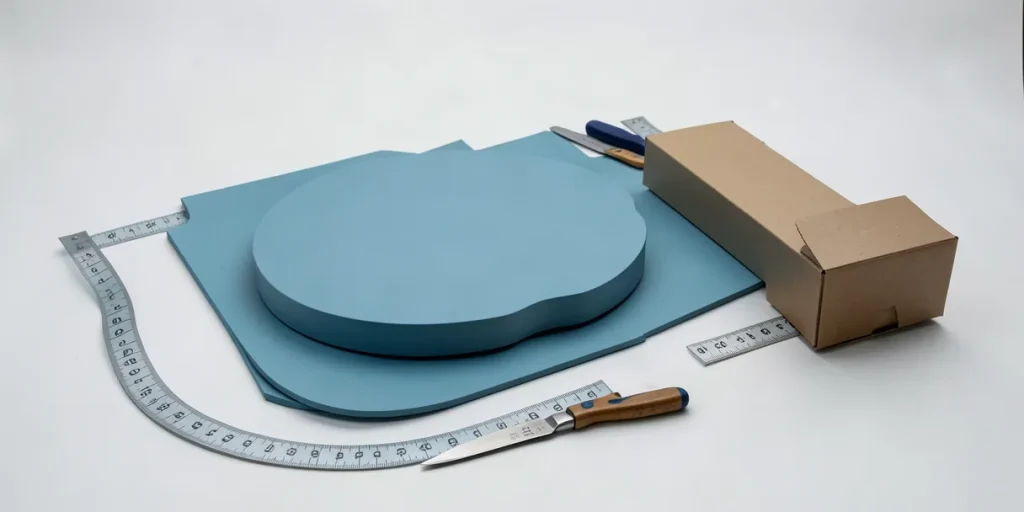
A product’s journey to production begins with an idea, which is turned into a design and tested with a prototype. The manufacturing process is then refined, quality is assessed, and production is prepared for repeatable output: the product must not only be functional, but also suitable for consistent manufacturing.
Manufacturing and technology connect the concept to the finished product through a series of decisions—from choosing materials and processes to inspecting the first items and setting up production. For more on how digital tools help turn an idea into a product, see our feature “Design and Technology: How Digital Tools Turn an Idea into a Product.”
| Operation | Cycle stage | What the source material says |
|---|---|---|
| Cutting | Processing | Named as an example of a processing method |
| Welding | Processing | Named as an example of a processing method |
| Casting | Processing | Named as an example of a processing method |
| Grinding | Processing | Named as an example of a processing method |
| Assembly | Product assembly | Follows the manufacture of parts |
| Quality control | All stages | Provided for throughout the cycle |
- 3D The type of model that begins the described design stage; this is a designation, not a statistical measure.
- 4 Processing examples named in the source material: cutting, welding, casting and grinding.
- September 2024 The month and year when the document outlining the program that includes the “Manufacturing and Technology” module was published.
What do manufacturing and technology mean in practice?
In practice, manufacturing and technology mean making a product through a consistent process that determines its shape, properties and quality and makes it possible to reproduce the result at scale. First, raw materials are used to create a designed model; then materials and equipment are selected, parts are processed, the product is assembled and its quality is checked.
The manufacturing cycle begins with design and modeling: this is where the appearance of the parts and the materials they will be made from are determined. Next, processing methods are chosen—for example, cutting, welding, casting or grinding—followed by assembly and inspection. This sequence is needed not just to make a single sample: the process must be repeatable in mass production, fast and defect-free. The source materials do not, however, give specific production timelines or acceptable defect rates.
A module in an educational program
“Manufacturing and Technology” is the name of a module in an educational program that covers the practical side of making products. The curriculum document was published in September 2024; it also gives the number of class hours: 68 hours in grades 6 and 7, and 34 hours each in grades 8 and 9. These figures show that the module is part of the curriculum, rather than being limited to a description of manufacturing operations.
How does a 3D model become a manufacturing plan?
From form to design
A 3D model becomes a manufacturing plan when the product’s form, parts and materials are matched to operations that can reproduce the design consistently. At the design stage, the model helps visualize the entire product in advance and assess how the concept relates to the planned processing and assembly stages.
When developing a model, it is important to consider more than its appearance: the chosen materials and the design of the parts must suit the manufacturing method. The production route may include cutting, welding, casting, grinding and assembly; the specific operations depend on the product. This helps identify in advance whether the design is compatible with the chosen manufacturing methods and whether it can be reproduced with the required properties and quality.
Digital design connects the product concept with its production: the model provides a basis for refining parts and choosing materials, and then helps align the design with the sequence of operations. For more on the relationship between digital tools and manufacturing, see our feature “Design and Technology: How Digital Tools Turn an Idea into a Product.”
How are materials and processing methods chosen?
Materials set the limits
Materials are chosen based on the product’s properties and shape, while operations and equipment are selected according to how it needs to be made. There is no universal list of suitable materials or numerical requirements here: the choice depends on the specific part.
Manufacturing depends not only on the material and the finished shape, but also on which operations can produce that shape. For example, cutting, welding, casting and grinding are different processing methods; none is mandatory for every product. Material preparation and equipment selection are part of the same manufacturing system as modeling and design.
- Cutting and grinding — processing options considered in light of the required shape and properties of the part.
- Welding and casting — other possible operations; whether they are suitable also depends on the product and the material chosen.
The manufacturing sequence is designed for each specific product, rather than automatically carried over from one part to another. Parts with different shapes or made from different materials may require different operations and equipment—which is why material preparation, modeling and design are interconnected.
How do assembly and quality control work?
Assembly turns processed parts into a finished product, while quality control takes place at every stage of production, not just after assembly. It is a distinct part of the manufacturing cycle: parts are joined into a product, which is then assessed against the required shape, properties and quality level.
What is checked during production
Checks at different stages help compare the results with product requirements as it is being made. Inspection does not apply only to the completed assembly: quality is also assessed during processing, so any deviation can be detected before the cycle is complete.
Inspection criteria depend on the requirements for the specific product—its shape, properties and quality. The source materials do not specify a particular standard, measuring instrument, tolerance or acceptable defect rate, so no numerical limits can be given here.
What does automation change, and what problems can it not solve?
Automation can help perform individual manufacturing operations, but it does not guarantee that a product will be ready for mass production: the design, material, equipment and quality control must all work together. The description of the manufacturing process mentions cutting, welding, casting, grinding, assembly and inspections, but names no equipment models or companies and gives no performance figures.
Where trade-offs arise
Production results depend on more than the processing method. First, a 3D model is created, the parts are designed and a material is chosen; if a mismatch is built in at this stage, subsequent processing or assembly will not automatically fix it. That is why quality control matters at different stages, not just when the finished product is inspected.
- Design: The parts in the 3D model must meet manufacturing and assembly requirements.
- Material: It is selected with the product’s properties, shape and manufacturing operations in mind.
- Equipment and operations: Cutting, welding, casting and grinding must suit the product and work well together; automation does not eliminate errors in the initial decisions.
- Inspection: Checks during production help detect deviations before assembly is complete.
The aim of mass production is to make products quickly and without defects, but the source materials do not specify production timelines, volumes or acceptable defect rates. The result therefore cannot be judged solely by whether an operation is automated: the entire manufacturing system must work in sync.
How does a finished product make its way to delivery?
A finished product is handed over to the recipient after manufacturing and quality control: delivery is an outcome of production, not a separate operation like cutting, welding or assembly. Before shipping, it is therefore important to make sure the product meets the required shape, properties and quality standards.
From idea to delivery
In the New Product Development (NPD) approach, a new product’s journey includes evaluating the idea, manufacturing, selling and analyzing profit. This helps connect the production stage to who the product is intended for and how it will be marketed, but the approach itself does not set universal timelines or financial outcomes.
When planning production at scale, product specifications need to be matched to the capabilities of mass manufacturing: materials, processing methods, equipment, assembly and quality control are all taken into account. At the same time, planners check whether the finished product can be offered to its intended recipient and sold afterward; otherwise, a technically feasible product may prove unsuitable for mass production or sale.
Frequently asked questions
Where does manufacturing a product begin?
Which processing methods may be used?
When is quality checked?
Does automation guarantee zero defects?
Key takeaways
- The manufacturing cycle brings together the 3D model, materials, equipment, processing, assembly and quality control.
- Cutting, welding, casting and grinding are examples of operations, not a universal set for every product.
- Quality control is needed at every stage, not just before delivery.
- Mass production depends on whether the design can be manufactured quickly and without defects.
Sources
- cehovik-erp.ru — “Product Manufacturing Technology — Cehovik ERP”
- online.hse.ru — “New Product Development (NPD): What It Is in Marketing, Types, Stages, and Process Launch Mistakes”
- businessmens.ru — “What to Make by Hand to Sell on Marketplaces: 85 Ideas”
- shopify.com — “25 Products You Can Make at Home and Sell (2026) — Shopify Belarus”
