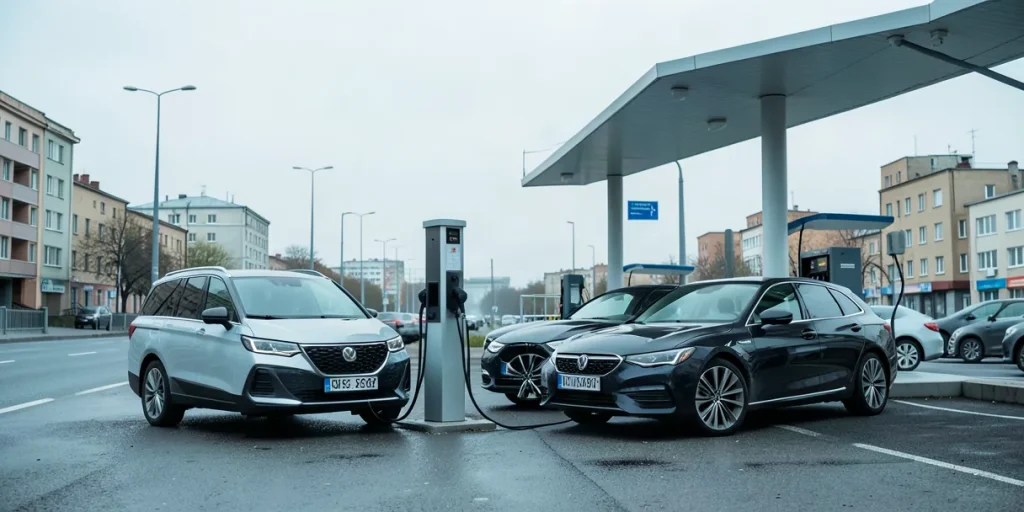
Choosing between a hybrid and an electric vehicle for city driving in 2026 depends on many factors: fuel savings, maintenance costs, charging infrastructure, and personal preferences. Electric cars are cheaper to run, but hybrids offer range and the flexibility of gasoline use. This article compares key aspects to help you decide.
Fuel Savings and Operating Costs
Hybrid cars combine an internal combustion engine and an electric motor, significantly reducing gasoline consumption compared to conventional vehicles. For example, the 2026 Toyota Prius achieves an average fuel consumption of about 3.3 l/100 km in urban driving. This is roughly half the fuel consumption of a traditional gasoline sedan in the same class.
Electric cars, like the 2026 Tesla Model 3, don’t use gasoline; costs are limited to electricity. In Russia, the average electricity cost for charging is around 5 ₽ per kWh, which translates to roughly 1 ₽ per kilometer driven. Maintenance costs for electric vehicles are lower since there are no oil changes, filter replacements, or transmission servicing, saving up to 30% on upkeep expenses.
Key Comparative Cost Indicators
- Hybrids save fuel by cutting gasoline consumption by up to 50% compared to conventional cars.
- Electric cars incur costs only for electricity and consumables; overall maintenance is 20–30% cheaper.
- Charging an electric car costs significantly less than gasoline for every 100 km driven.
Purchase Price and Model Availability
Prices for hybrids and electric vehicles continue to fall in 2026, but electric cars still cost more in base trim. For instance, the 2026 Toyota Prius hybrid starts around 2,400,000 ₽, whereas the Tesla Model 3 electric car starts at about 3,200,000 ₽.
In the Russian market, hybrids also include the Kia Niro Hybrid and Hyundai Ioniq Hybrid, priced between 2,100,000–2,800,000 ₽. Electric vehicles, besides Tesla, include the Nissan Leaf and Volkswagen ID.3, starting at 2,900,000 ₽.
Price Comparison of Popular 2026 Models
| Model | Type | Price (₽) | Average Fuel/Energy Consumption |
|---|---|---|---|
| Toyota Prius | Hybrid | 2,400,000 | 3.3 l/100 km |
| Kia Niro Hybrid | Hybrid | 2,100,000 | 4.0 l/100 km |
| Tesla Model 3 | Electric | 3,200,000 | 18 kWh/100 km |
| Nissan Leaf | Electric | 2,900,000 | 17 kWh/100 km |
Charging Infrastructure and Convenience in the City
In urban settings, the availability of charging stations is crucial for electric cars. Moscow and Saint Petersburg have over 10,000 public chargers, but smaller cities and regions have less developed infrastructure.
Hybrids do not require special chargers, offering greater freedom of movement. Plug-in hybrids (PHEVs), like the Mitsubishi Outlander PHEV, can be charged from the grid but operate as regular hybrids when no charger is available.
Charging Types and Energy Replenishment Times
- Fast charging (DC) – 30–40 minutes to reach 80% charge.
- Standard charging (AC) – 6–8 hours for a full charge.
- Hybrids don’t rely on charging infrastructure; refueling takes 3–5 minutes.
Environmental Impact and Eco-Friendliness
Electric vehicles produce zero exhaust emissions during operation, which is especially vital for megacities facing air pollution challenges. According to the Russian Ministry of Ecology, electric cars reduce CO2 emissions by 40–60% compared to gasoline cars, considering the average Russian energy mix.
Hybrids also reduce emissions but continue using gasoline, so their effectiveness depends on driving style and conditions. For instance, in traffic jams, hybrids can run mostly on electric power, lowering local pollution.
Environmental Metrics
- 0 g/km CO2 emissions from electric cars while driving
- 70–90 g/km CO2 emissions for hybrids in mixed driving
- up to 50% reduction in urban air pollution when replacing a gasoline car with an electric vehicle
Comfort and Technical Features of Operation
Electric cars provide smoother and quieter rides due to the absence of an internal combustion engine, enhancing city comfort. They also deliver instant torque, ideal for dynamic urban traffic.
Hybrids, especially parallel types, can switch between electric motor and engine, offering a range up to 800 km. This suits drivers who rarely charge or frequently travel outside the city.
Technical Pros and Cons
- Electric cars: low maintenance but dependent on charging and limited range (typically 350–450 km).
- Hybrids: more complex maintenance due to two powertrains but longer range and gasoline backup.
Frequently Asked Questions
Which is more cost-effective for daily city trips — a hybrid or an electric car?
Is it necessary to install a home charging station for an electric car?
How often does a hybrid car need maintenance?
How much does it cost to charge an electric car for 100 km?
Key Takeaways
- Electric cars offer lower operating and maintenance costs in urban settings.
- Hybrids provide flexibility and range without relying on charging infrastructure.
- Electric vehicles have higher purchase prices, but the gap is narrowing.
- Electric cars are significantly more eco-friendly, crucial for large cities.
- The choice depends on charger availability, driving routes, and personal habits.
Ultimately, if you live in a major city with good charging infrastructure and mostly take short trips, an electric car is a more economical and eco-friendly choice. If you often drive long distances without quick charging options, a hybrid is more practical thanks to its combination of gasoline and electric power. Careful analysis of your needs and local infrastructure will help you make the right decision in 2026.
Sources
- teslashop.by — «Electric Car or Hybrid: Which to Choose?»
- ev.megapolis.by — «Electric Car or Hybrid: Differences and Choice»
- BENY New Energy — «Hybrid or Electric Car: Which to Buy?»
- major-auto.ru — «Hybrid Cars: Types, How They Work, Differences, and Whether to Buy — Major Auto Blog»
- e-vai.com — «Hybrids and Electric Cars: Specifications and Differences — E-VAI»