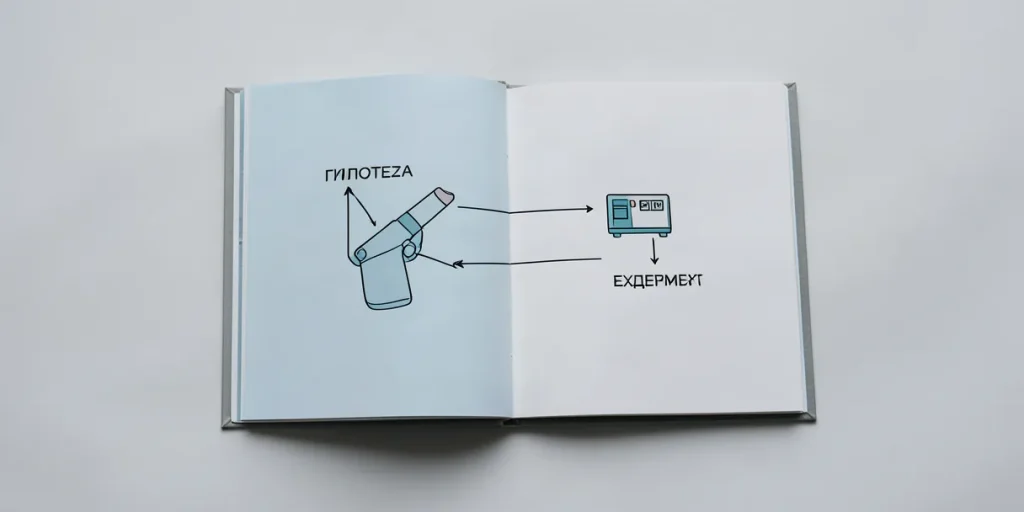
The method of inquiry works as a sequence of steps: a researcher formulates a question, gathers observations or data, tests an assumption, and evaluates the result. If a conclusion withstands scrutiny and can be reproduced, it becomes part of verifiable knowledge; if not, the hypothesis is revised. In this way, science and education help us not merely absorb answers, but understand how they are obtained.
This approach applies across disciplines, although the specific tools differ: a biologist may observe living organisms, while logic helps analyze the course of reasoning. To learn how the methods of particular fields work, read our articles “Biological Sciences: Key Fields and Research Methods” and “The Science of the Laws of Thought: Logic and Its Main Tools.” The article “Science Is a System of Verifiable Knowledge and Ways of Obtaining It” explores the broader meaning of verifiable knowledge.
| Field or method | What it studies or does | Specific example |
|---|---|---|
| Biology | Living organisms | Studying animal behavior |
| Ethology | Animal behavior | Observations and experiments |
| Mycology | Fungi | Classifying the fungal world |
| Ichthyology | Fish | Studying life in aquatic ecosystems |
| Scientific method | Researching and testing explanations | Observation, hypothesis, experiment |
- XX century period when the hypothetico-deductive model of the scientific method was formulated
- 1768 year date given for “An Experiment on a Bird in the Air Pump”
- 3 fields nature, society, and thought — the fields mentioned in the description of science
- 2 methods observation and experiment, identified as the foundations of the scientific method
What connects science and education?
Science and education are connected by the pursuit of well-founded knowledge: science obtains and systematizes information about nature, society, and thought, while education introduces people to this information and teaches them to examine the grounds for claims. That is why a lesson on the scientific method focuses on more than its stages: the method itself becomes both a subject to learn and a tool for working with educational material.
From observation to testing
The scientific method helps students move from an observable phenomenon to a testable explanation. For example, in a school assignment, they can first describe exactly what they observe, then formulate a hypothesis and devise an experiment whose results can test it. This process follows the hypothetico-deductive model formulated in the 20th century.
Rather than memorize a single ready-made answer, students can compare a hypothesis with observations and experimental results. A shared principle of science and education is to distinguish a claim from the grounds on which it rests: in schoolwork, this means asking which facts support an explanation and how it can be tested.
What is the scientific method, and how does it work?
Observation and hypothesis
The scientific method is a system of practical and theoretical research procedures that helps explain observable phenomena, organize knowledge, and revise previous explanations. In the hypothetico-deductive model, formulated in the 20th century, research begins with observation: a scientist notices a fact and proposes a hypothesis that could explain it.
A hypothesis should lead to expected consequences that can be compared with the results of a test. For example, if a proposed explanation is correct, an experiment should produce a particular result; if it does not, the hypothesis must be refined or rejected. In this way, the method links observation, theoretical reasoning, and practical testing rather than reducing science to a single experiment.
Testing and revision
The experiment on a bird in an air pump, dated 1768 in the supplied material, is a specific example of an experiment, not a mandatory template for every study. Testing methods depend on the question: in one case, an experiment is appropriate; in another, a researcher may systematize observations or revisit an existing explanation.
The scientific method matters not because it guarantees an unchanging answer, but because it allows the grounds for an explanation to be tested and the explanation to be adjusted in light of new results. In the model described here, the key sequence is observation, hypothesis, deduction of expected consequences, and comparison of those consequences with an experiment.
How do scientific fields and classifications differ?
Scientific fields differ in what they study and the questions they ask: the sciences investigate nature, society, and thought, while disciplinary boundaries are defined by the object and purpose of a study. The same object can therefore be examined from different angles, using methods suited to a particular question.
Biology studies living organisms, while ethology focuses on animal behavior. If a research question concerns behavior, observing animals’ actions helps study that particular aspect of their lives; a different task may require other methods. Specialization narrows the subject without completely separating it from the broader field of biology.
How specialization sharpens the focus
Mycology studies fungi, while ichthyology studies fish: these names show how disciplines select specific groups of organisms for research. When classifying the sciences, it is important to consider both the object and the research question—a field’s name alone does not always reveal exactly what a study examines. For more on disciplinary boundaries, read “Classes of Sciences: Principles of Classification and Connections Between Disciplines”; for more on branches of biology, see “Biological Sciences: Key Fields and Research Methods.”
How does the scientific method help us learn?
The scientific method helps us learn by turning questions into testable assumptions and teaching us to compare explanations with observable facts. In a lesson, students first describe an observation, then formulate an explanation and clarify in advance which result would support it and which would require them to revise it. This helps them distinguish an assumption that can be tested from an answer unrelated to observable data.
In biology, observing animals and conducting experiments serve different research purposes: observation makes it possible to study behavior without deliberately changing conditions, while an experiment tests what happens when conditions are changed. The choice depends on the question: observations are suitable if the goal is to describe behavior; an experiment is needed to find out whether a change in conditions is linked to a result. A specific research plan starts by stating exactly what will be observed or changed and what result will count as support for the explanation.
How to test reasoning
Logic helps determine whether a conclusion follows from its premises, while the scientific method adds a test of the explanation itself: does it agree with the facts observed or found in an experiment? The hypothetico-deductive model, formulated in the 20th century, starts with observation, proposes a hypothesis, and tests its consequences. This approach connects classroom reasoning with the development of scientific knowledge and research, as discussed in more detail in “The Development of Science: From Observations to Interdisciplinary Research.”
Where is the scientific method limited, and what mistakes get in the way?
An assumption is not the same as proof.
The scientific method has limits: a single observation does not confirm a hypothesis, and an experiment is not suitable for every research subject. Mistakes arise when an assumption is called an established fact or when people assume that inquiry is impossible without experiments.
An observation can provide grounds for a hypothesis, but the hypothesis must be tested: does it explain the observed fact, and is it consistent with other results? Until it has been tested, a hypothesis remains an assumption. Confusing these terms obscures what still needs to be established.
Research methods are chosen with the subject in mind: experiments are used where they can be conducted, while other cases call for observation, theoretical analysis, or systematizing previously acquired knowledge. For example, descriptions of the scientific method include not only obtaining new data, but also organizing and revising it.
- Observation: makes it possible to record phenomena, but by itself does not establish that a hypothesis is correct.
- Experiment: is suitable for testing when the conditions of the study allow it to be conducted.
- Theoretical analysis and systematization: are used when a researcher studies relationships between concepts or knowledge already acquired.
A number in a course title or the phrase “science 2” does not point unambiguously to a discipline: its meaning depends on context. Different interpretations of this label are discussed in the article “Science 2: What This Label Could Mean in Education and Research.”
How can you learn more about specific sciences?
You can learn more about specific sciences by choosing a particular field—ethology, mycology, or ichthyology—and then exploring scientific terms and the general principles of the method. For animal behavior, a good starting point is the article “The Science of Animal Behavior: Ethology, Observations, and Experiments,” which focuses on observation and testing explanations. Fungi are covered in “The Science of Fungi: Mycology and the Diversity of the Fungal World,” and fish in “The Science of Fish: Ichthyology, Classification, and Life in Aquatic Ecosystems.”
To make sense of terms and numbers in course titles, explore these three articles: “Sciences: How to Make Sense of the Labels ‘Science 1’ and ‘Science 2,’” “Sciences 4: How to Interpret the Number in a Science Course Title,” and “Science 3: How to Understand the Meaning of the Title in Different Contexts.” Compare labels with their context: the number in a title alone does not explain which discipline or course content it refers to.
From a specific topic to the general method
For a broad overview, see “Science Is a System of Verifiable Knowledge and Ways of Obtaining It” and “5 Sciences: Five Fields of Knowledge and the Questions They Answer.” The article “Science 2.0: What This Approach to Open Data and Collaboration Means” focuses on the open exchange of knowledge. The scientific method connects these topics: observations and experiments help test hypotheses, and the results help refine explanations.
Frequently asked questions
What is the scientific method in simple terms?
Where does scientific research begin?
How is a hypothesis different from a theory?
Does science always have to conduct experiments?
Key takeaways
- The scientific method links observation, hypothesis, and testing; it is about more than accumulating facts.
- The hypothetico-deductive model was formulated in the 20th century.
- Biology, ethology, mycology, and ichthyology differ primarily in their objects of study.
- A single observation does not turn a hypothesis into a proven fact.
Sources
- Humanities Portal — “Methods of Scientific Inquiry”
- cyberleninka.ru — “Developing Students’ Understanding of”
- lihachev.ru — “THE SCIENTIFIC METHOD OF INQUIRY IN SCHOOL”
- spbti.ru — “Lecture 1. The Concept of Science, Its Structure and Functions”
