Updated: August 28, 2026
Recent studies conducted by scientists have shed light on the mystery of square holes found in the helmets of medieval warriors. These unusual damages have long sparked debates among historians and archaeologists attempting to determine what weapon could have left such strange marks. Through years of analysis and the application of modern technologies, researchers have established that the cause of these holes were specific types of weapons used in battles of that time.
The study focuses on the materials and constructions used in armor, as well as the types of implements that could inflict such damage. Scientists examine both historical sources and archaeological finds to create a more comprehensive picture of medieval warfare and the evolution of weaponry. These discoveries not only deepen our understanding of military history but also provide a new perspective on the life and death of warriors of those times.
Introduction to the Mystery of Square Holes
The mystery of the square holes found in the helmets of medieval warriors has become a subject of active research among scientists and historians. These unique damages were first identified on the remains of warriors who fell in the Battle of Visby in 1361. The historical context of this battle, which pitted the forces of the Danish king against Swedish rebels, provides a backdrop for understanding the supposed causes of such unusual injuries. Eighteen warriors, whose skulls were examined, exhibited characteristic square holes, prompting researchers to question what type of weapon could have left such marks.
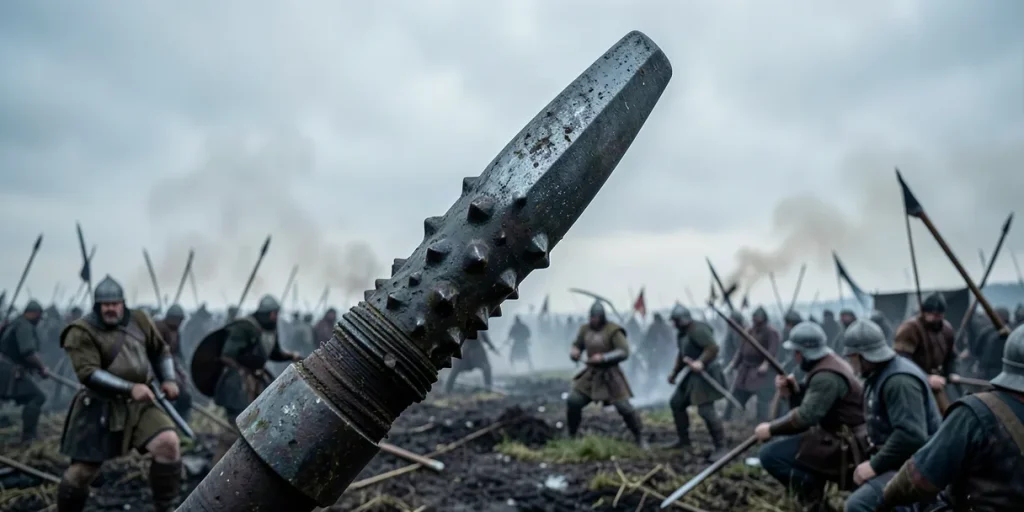
Initially, researchers considered several weapon options, including crossbows and axes. However, experiments conducted using replicas of various medieval implements revealed that neither the crossbow nor the axe left damages resembling those found in the helmets. In contrast, the spiked mace showed a perfect match with the shape and characteristics of the square holes. This discovery allowed scientists to conclude that it was indeed the strikes from spiked maces that caused these unusual injuries.
The significance of these findings for archaeology and history cannot be overstated. They not only illuminate the tactics of medieval combat but also enhance our understanding of the weaponry and methods of fighting of that time. Establishing a link between the type of weapon and the nature of the injuries may change perceptions of military conflicts such as the Battle of Visby, as well as the role that implements like the spiked mace played. These studies open new horizons for further archaeological inquiries and historical reconstructions, deepening our understanding of the life and death of warriors in medieval Europe.
Research Methods
The research methods employed by scientists to analyze the square holes in the helmets of medieval warriors included a comprehensive approach that combined both historical reconstructions and modern technology. Researchers began by creating accurate replicas of medieval weapons to reproduce the conditions of battles at that time. Specifically, spiked maces, crossbows, and axes were crafted for experimental purposes.
One of the key stages of the research involved using a motion capture system that allowed for a detailed analysis of the strikes inflicted by various implements. Historical reconstruction expert Ray Witcher, dressed in a specialized motion capture suit, struck targets simulating skulls. The system recorded parameters such as trajectory, force, and angle of impact, enabling precise data on the consequences of each strike.
Analysis of the data obtained showed that the crossbow and axe did not leave characteristic square damages that were found on the helmets of medieval warriors. In contrast, the strikes from the spiked mace left damages virtually identical to those discovered in historical finds. This coincidence was a decisive factor in identifying the source of the square holes.
Scientists also conducted a statistical analysis of the data, confirming the significance of the results. It was found that the damages left by the spiked mace differed in shape and size from those that could have been inflicted by other types of weapons, such as arrows or thrown spears. Thus, the experiments not only helped unravel a historical mystery but also contributed to the understanding of tactics and weaponry in medieval battles.
In conclusion, the combination of historical reconstruction and modern technologies allowed scientists to draw important conclusions about the nature of injuries sustained in battle and to uncover secrets that had remained a mystery for centuries.
Types of Weapons and Their Impact
Modern research conducted by scientists has helped clarify which weapons left square holes in the helmets of medieval warriors. Initially, several potential sources were considered, including crossbows, axes, and spiked maces. However, experiments demonstrated that crossbows and axes did not cause the characteristic damages in question. In contrast, strikes delivered by spiked maces left precisely such square marks, which became a key factor in solving this mystery.
Crossbows, despite their power and range, did not leave square holes. Their projectiles typically have a streamlined shape, making the damages they inflict more rounded and less distinctive. Similarly, while axes can deliver powerful blows, they also do not leave square marks. These implements generally create deeper but sharper wounds, which significantly differ from the characteristic damage left by spiked maces.
The spiked mace, as researchers discovered, has a unique shape and construction. Replicas of these implements were used in the study, and during experiments, it was established that they were indeed capable of creating square holes. The spikes and shape of the mace allow for strikes that penetrate the skull with characteristic damage. This discovery not only confirms the power and effectiveness of the spiked mace in combat but also provides us with important data on the tactics of medieval fighting.
Thus, the research provided new insights into how different types of weapons influenced the outcomes of battles and the nature of the injuries they inflicted. This knowledge assists not only archaeologists but also historians in reconstructing the scenes of medieval fights and the tactics employed at the time.
Results of the Experiments
The results of the experiments showed that the mysterious square holes in the helmets of medieval warriors, found during archaeological excavations, were caused by strikes from the spiked mace, rather than other types of weapons, as previously assumed. Researchers conducted a series of experiments using replicas of various types of weapons, including crossbows and axes, to determine the source of these unique damages. Parameters of the strikes, such as force, angle, and trajectory, were recorded using specialized equipment, allowing for precise data acquisition.
During the experiments, it was established that the crossbow and axe did not leave characteristic square marks on materials simulating human skulls. In contrast, strikes from the spiked mace left damages identical to those found in historical finds. This coincidence became a decisive factor in identifying the source of the square holes.
Scientists also conducted a statistical analysis of the obtained data, confirming the significance of the results. It was found that the damages left by the spiked mace differed in shape and size from the marks that could have been left by other types of weapons, such as arrows or thrown spears. Thus, the experiments not only helped solve a historical mystery but also contributed to the understanding of tactics and weaponry in medieval battles.
In conclusion, the results of the experiments emphasize the importance of scientific research in archaeology and history. They not only expand our knowledge of the past but also help reconstruct the picture of life in medieval societies. The discovery that the spiked mace was the primary weapon leaving square holes opens new horizons for further research and discussions in the scientific community.
Historical Significance of the Findings
Recent discoveries regarding the square holes in the helmets of medieval warriors have significantly altered our understanding of military tactics and the weaponry used in the 14th century. Research has shown that these damages were caused by strikes from a spiked mace, rather than arrows or crossbows, as previously assumed. This conclusion was reached through experiments with weapon replicas that allowed for an accurate recreation of typical injuries. Thus, we gain a more comprehensive view of how battles were fought and which types of weapons were most effective in combat during that time.
These findings also have significant implications for the reconstruction of historical battles. Understanding what weapons were used and how they impacted the opponent enables historians and reenactors to create more accurate and plausible battle scenarios. This could change the approach to creating historical reconstructions, as well as educational programs dedicated to medieval history. Now, reenactors can not only recreate the images of warriors but also consider tactical elements related to the use of spiked maces.
Furthermore, the results of the research open new avenues for further scientific inquiries in archaeology and history. Scientists can delve into the study of the materials and technologies used in weapon production, as well as explore the impact of different types of weaponry on combat tactics. The ability to conduct new experiments with weapons and their effects on protective armor and skulls will allow for a more accurate assessment of the consequences of military actions and their influence on historical events.
Thus, the findings related to square holes in helmets not only enrich our knowledge of medieval warfare but also open new paths for further research and reconstructions, ultimately contributing to a deeper understanding of the historical context and cultural characteristics of that time.
Technologies and Their Role in Scientific Research
Modern technologies play a key role in archaeology, allowing scientists to make discoveries that previously seemed impossible. In particular, the application of innovative methods, such as 3D modeling and computed tomography, has significantly improved the process of analyzing artifacts and remains. For example, in the study of square holes in the helmets of medieval warriors, weapon replicas and specialized systems for tracking strikes were used, enabling precise identification of the spiked mace as the source of the characteristic damages. Such technologies allow not only for the reconstruction of past events but also for their visualization, making the information more accessible and understandable.
Technologies also facilitate a deeper understanding of historical events. By analyzing data obtained from archaeological excavations, scientists can create detailed reconstructions of battles, analyze warriors’ tactics, and even identify the reasons for their defeats or victories. The use of virtual reality allows researchers and viewers to be ‘transported’ back to those distant times, making the study of history an interactive and engaging process. This, in turn, opens new horizons for educational programs and museum exhibitions.
The future of scientific research in history and archaeology promises to be even more exciting. With the advancement of technologies such as artificial intelligence and machine learning, the possibilities for data analysis and interpretation are significantly increasing. Scientists will be able to process vast amounts of information, uncovering hidden patterns and connections that previously went unnoticed. This could lead to new discoveries and a rethinking of already known histories.
Thus, technologies not only enrich our knowledge base but also change the very approach to studying history, making it more scientific and precise. Ultimately, they become an integral part of archaeological research, opening new horizons for understanding our past.
Expert Opinions
Recent studies conducted by scientists and their results regarding the square holes in the helmets of medieval warriors have sparked great interest among historians and archaeologists. The scientific community has noted that the use of the spiked mace as an implement that leaves such characteristic damages changes the perception of medieval battles and combat tactics. According to historians, this discovery emphasizes the importance of experimental archaeology, which allows not only for the analysis of finds but also for reproducing the conditions under which they were obtained. Studies conducted using weapon replicas provide an opportunity to gain deeper insights into the mechanisms of injury infliction and the nature of battles of that time.
The public also plays a significant role in the perception of historical finds. With the emergence of information about the square holes in the helmets, many people have become interested in medieval history and culture, fostering discussion and popularization of scientific research. Experts believe that such discoveries can inspire new projects in historical education, as well as the creation of exhibitions and lectures dedicated to this subject. It is important for society to be involved in the process of studying history, as this fosters a more conscious attitude towards cultural heritage.
Changes in the perception of medieval culture also relate to broader questions about violence and its place in society at that time. On one hand, discoveries regarding the use of spiked maces highlight the brutality of the era; on the other hand, they open new horizons for understanding social structures and military organization. As archaeologists note, such findings offer better insights into how technologies and tools influenced warfare and how they shaped social norms and values.
Thus, the discovery of square holes in the helmets of medieval warriors not only adds new strokes to the picture of historical past but also raises important questions for further research and public discussion.
Conclusion
In conclusion, the results of the recent study on square holes in the helmets of medieval warriors open new horizons for understanding the types of weapons used in those battles. It has been established that the cause of these unique damages were strikes from the spiked mace, rather than crossbows or axes, as previously thought. Experiments with replicas of weapons allowed scientists to analyze the mechanisms of striking and their marks in detail, adding further value to these finds. These discoveries not only enrich our knowledge of military tactics and technologies of the Middle Ages but also underscore the importance of applying scientific methods in historical research.
Preserving historical heritage, including artifacts such as the remains of warriors and their weapons, is of immense significance for future generations. Each find is not just a piece of history, but a whole story about the lives, battles, and cultures of people who lived in the past. Discussing and studying such topics shapes our understanding of humanity and its development. It is important for the scientific community to continue supporting research aimed at uncovering historical mysteries and to draw public attention to the significance of archaeological finds.
In the future, researchers may focus on several directions. Firstly, it is worth delving into the study of other types of weapons used in the Middle Ages and their impact on the human body. Secondly, it would be beneficial to conduct broader archaeological excavations at historical battle sites to gather more data on weaponry and tactics of that time. Finally, consideration should be given to the possibility of using modern technologies, such as 3D modeling and virtual reality, to visualize historical events and weapons, helping to attract interest in history and its studies.
Thus, this research not only sheds light on specific aspects of military history but also emphasizes the need for further inquiries and discussions so that we can better understand our past and preserve it for future generations.
