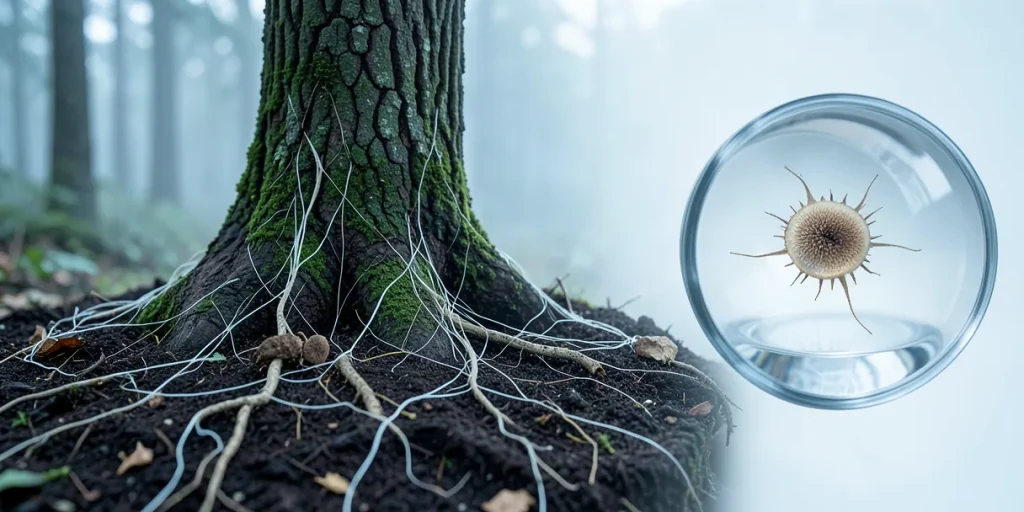
Mycology is a branch of biology that studies fungi: their structure, life cycles, diversity, distribution and interactions with other organisms. It helps us understand the role fungi play in nature and human life.
Fungi are neither plants nor animals, but a distinct group of organisms with their own ways of feeding and reproducing. That is why the science of fungi brings together different fields, from the study of forest species and yeasts to research on fungi associated with food, health and technology.
To see how mycology fits into the broader system of knowledge, read our overview, “Science and Education: How We Make Sense of the World and What the Scientific Method Teaches Us.”
| Field | What it studies |
|---|---|
| Morphology | Fungal structure |
| Systematics | Identification and classification |
| Ecology | Fungi’s relationships with their environment |
| Physiology | Life processes |
| Phylogeny | Relatedness and evolutionary history |
- 5% Estimate of the known share of fungal diversity, cited by MSU professor Alexander Kurakov in an interview
- 2 parts A simplified distinction between the mycelium and fruiting body; this is not a comprehensive classification
- 6 fields Morphology, biochemistry, systematics, ecology, physiology and phylogeny, named in a description of mycology’s subject matter
What does the science of fungi study?
Mycology is a branch of biology that studies fungi: their structure and life processes, classification, chemical processes, relationships with their environment, evolutionary relatedness and distribution. The name of the science comes from Greek words meaning “fungus” and “study.”
From fungal structure to its place in nature
Morphology describes how fungi are built, while physiology studies how they grow and sustain their life processes. For example, mycelium consists of filaments; when these are damaged, the fungus repairs the affected areas to prevent cytoplasm from leaking out.
Systematics helps identify and classify fungi, while phylogeny examines their relationships and evolutionary history. Ecology looks at how fungi interact with their surroundings, and the study of distribution shows where they occur. Together, these fields help us understand fungi’s role in natural communities and human life.
What exactly do mycologists call a fungus?
A fungus is an organism that mycology studies as a whole: not just the visible fruiting body, but also the mycelium—a network of fungal filaments usually hidden in the substrate. So a cap fungus found in the forest reveals only part of the organism, not its full structure and life.
Mycelium and fruiting body
The mycelium and fruiting body are different parts of a fungal organism: the mycelial filaments form its network, while the fruiting body is a visible structure associated with reproduction. If a mushroom picker cuts off the fruiting body, that is not the same as removing all the mycelium; looking only at the cap does not reveal what is happening to the fungus in the substrate.
When mycelium is torn, the fungus repairs the damaged areas to stop cytoplasm from leaking out. This process shows why mycologists consider not only a fungus’s appearance but also the condition of its filaments. Mycology also examines fungus-like organisms, but a similar appearance or certain shared abilities do not, by themselves, make them true fungi: they must be distinguished as separate subjects of study.
How does mycology study fungi?
Mycology studies fungi by describing their structure and composition and investigating how they live, where they occur and how they relate to other organisms. Researchers use several approaches: morphology helps characterize a fungus’s form and structure, while systematics compares traits to distinguish and classify organisms.
Biochemical and physiological research focuses on the composition of fungi and their life processes. An ecological approach examines fungi’s relationships with their environment, while the study of distribution helps establish where they occur and under what conditions. These fields complement one another: information about an organism’s structure and internal processes can be considered alongside its place in nature.
Relatedness and research institutions
Phylogeny helps unravel relationships among fungi and understand their place in the broader history of organisms. Mycological research in its various forms is represented, for example, at the Department of Mycology and Algology at the Faculty of Biology of Moscow State University. It is a concrete academic example of how the study of fungi brings together questions of classification, life processes and relationships with the environment.
Why is fungal diversity not yet fully understood?
Fungal diversity is not fully understood because a significant part of it has yet to be discovered and described by mycologists. In an interview, MSU professor Alexander Kurakov summed up the scale of the gap: “We know only 5% of all fungal diversity.” This estimate reflects the state of knowledge as a whole, not the idea that all species and groups are equally poorly studied.
Fungi cannot be reduced to the visible fruiting bodies people gather in the forest: a fungal organism may go unnoticed in ordinary observation. So knowing porcini, orange-cap boletes, slippery jacks or button mushrooms does not mean that someone knows the entire fungal world. What can be seen while foraging is just one part of the diversity studied by mycology.
Discovery and description are also part of mycology
Mycology not only investigates species that are already known, but also searches for organisms yet to be recognized and described. This is a distinct research task, alongside the study of the systematics, morphology and ecology of known fungi. Kurakov’s estimate of 5% underscores why documenting diversity remains an important part of the science of fungi.
What role do fungi play in nature and the economy?
Fungi support natural communities and have practical importance for people: ecological mycology studies their relationships with other organisms, while applied fields explore their use in medicine and industry. In nature, fungi interact with neighboring species, so researchers need not only to describe individual organisms but also to understand their place in a community.
From natural relationships to practical applications
Applied mycology explores properties of fungi and fungus-like organisms that may be useful to people. Among the possibilities being studied are generating electricity and processing waste; these are areas of research, not evidence that a ready-to-use industrial solution already exists.
To assess an application’s potential, scientists need to establish exactly how the relevant property manifests itself and under what conditions it works. For example, finding that an organism can contribute to electricity generation is not enough: researchers separately investigate the mechanism and the conditions that determine whether the process can be reproduced. This approach helps distinguish a promising biological observation from a technology suitable for medicine or industry.
Can fungi feel pain when their fruiting body is cut off?
What we know about mycelial damage
There is no basis for thinking that a fungus feels pain when someone cuts off its fruiting body: the repair of damaged mycelium is an observable biological response, not proof of a subjective experience. In an interview about fungi, Professor Alexander Kurakov noted that such pain is unlikely.
Mycelium consists of filaments, and when they break, the fungus repairs the damaged area, limiting the loss of cytoplasm. This repair shows that the organism responds to physical damage and maintains the integrity of its mycelium; by itself, it does not show that the fungus feels pain.
- Break in a mycelial filament: the damaged area must be repaired and cytoplasm loss limited.
- Cutting off the fruiting body: the action affects the visible part of the fungus; the mycelium’s response to damage does not confirm that it feels pain.
A common mistake is to equate tissue repair in fungi with the human experience of pain. The fact of repair alone is not enough to support that conclusion: it describes a process of recovery but does not establish whether a fungus has a subjective sensation.
Where should you start learning about mycology?
A good place to start learning about mycology is with two distinctions: between the fruiting body and the mycelium, and between observation and inference. The cap and stem are the visible part of a fungus, while the mycelium is a system of filaments; seeing a fungus on the surface does not, by itself, tell you everything that is happening to the mycelium.
One useful way to explore mycology is through four fields: systematics determines which group a fungus belongs to; morphology describes its structure; ecology examines its relationships with the environment; and physiology studies its life processes. For example, the shape of a fruiting body can be described morphologically, but understanding the fungus’s role in nature requires ecological questions. These fields are part of mycology alongside the study of fungal biochemistry and distribution.
Why familiar mushrooms are not enough
Porcini, orange-cap boletes and slippery jacks are familiar examples, not a model of all fungal diversity. The headline of an interview with MSU professor Alexander Kurakov gives this estimate: “We know only 5% of all fungal diversity.” It helps explain why everyday observations do not provide the full picture. Beginners should separate what they have directly observed from assumptions about the organism’s unseen parts and properties. To learn how verifiable knowledge is built, read our explainer, “Science and Education: How We Make Sense of the World and What the Scientific Method Teaches Us.”
Frequently asked questions
What is the science of fungi called?
What is mycelium?
How much of fungal diversity is known?
Does it hurt a fungus when its fruiting body is cut off?
Key takeaways
- The science of fungi is mycology; its fields include morphology, systematics, biochemistry and ecology.
- Mycelium is a network of fungal filaments, and the fruiting body is not the whole fungus.
- MSU professor Alexander Kurakov estimated that the known share of fungal diversity is 5%.
- Mycology also studies fungi’s potential applications, including waste processing.
Sources
- scientificrussia.ru — “We know only 5% of all fungal diversity.” Interview with MSU Professor Alexander Kurakov
- kispark.ru — “Conservation Science: Mycology”
- forum.toadstool.ru — “MYCOLOGY IS AN EXACT SCIENCE! (A mushroom picker’s reflections”
- VK — “The history of mycology #medach_myco… | Medach | Medical Channel”
