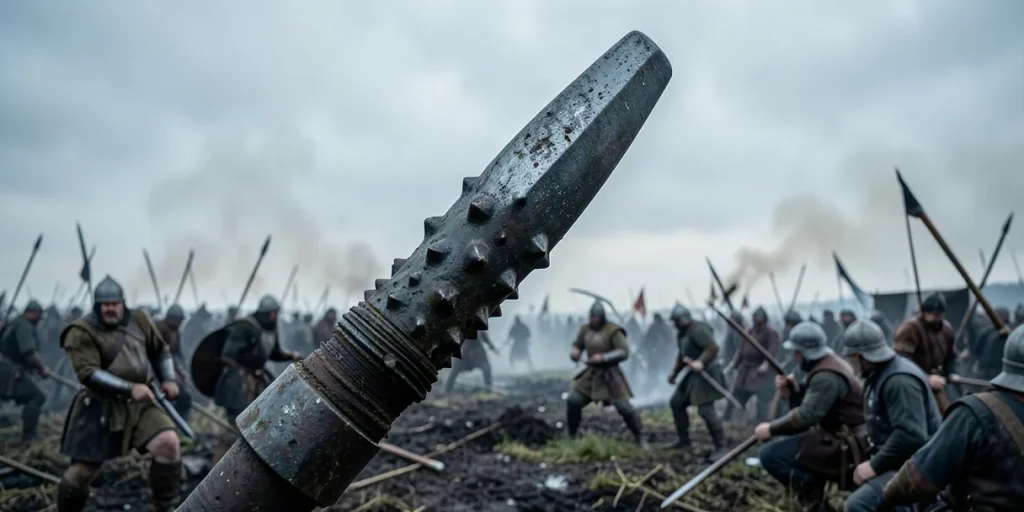
Square injuries on the skulls of warriors killed at the Battle of Visby in 1361 have been linked to blows from a mace with protruding spikes. Researchers reached this conclusion not from the shape of the holes alone: they compared skeletal injuries with damage made by experimental weapon replicas.
This is a more cautious conclusion than claiming to have found a weapon that always pierces a skull in a square shape. A wound’s shape depends on the design of the striking end, the angle and force of the blow, and how the bone healed or deteriorated after burial. The study identifies the closest match among the options tested, not proof for every Visby injury.
- 1361 — the year of the Battle of Visby on the island of Gotland
- 18 skulls — the number of cases cited in the study description
- Spiked mace — the type of weapon whose experimental marks best matched the square injuries
Introducing the mystery of the square holes
The Battle of Visby took place in 1361 outside the walls of a town on the Swedish island of Gotland. The forces of King Valdemar IV of Denmark fought local troops; the mass graves of the dead have made the site an important source of evidence about medieval injuries. Among the remains, researchers found skulls with localized damage described as square or nearly square.
Accounts of the mystery mention 18 skulls bearing such marks. That number alone does not show the proportion of all those killed or how common a particular weapon was: answering those questions requires complete data on the sample and the criteria used to count cases. It is also important to remember that “square hole” is a brief description of an injury’s shape, not a diagnosis that identifies the weapon on its own.
Crossbow bolts and axe blows were initially discussed as possible causes. Experimental comparisons showed that, in the tests conducted, blows from a mace with a protruding striking surface were the closest match. Popular accounts often call it a spiked club; more precisely, it is better described as a mace or spiked striking weapon, since the everyday word “club” says nothing about the exact design of the artifact or replica.
The conclusion concerns the nature of the injuries, not the entire course of the Battle of Visby. The shape of an injury cannot reveal the attacker’s identity, the number of blows struck during the fight, or when the warrior died. Those questions require other evidence, including the location of wounds on the skeleton, the archaeological context, and comparisons with weapons from the same site.
Research methods
The researchers tested their hypotheses experimentally: they made replicas of several types of weapons and compared the damage they caused with injuries on the skulls. The options included a crossbow, an axe, and a mace with protruding elements. This approach is known as experimental archaeology: researchers recreate particular actions from the past to test what kinds of marks they might leave.
The study description mentions historical reconstruction specialist Ray Witcher and a motion-capture system. Sensors recorded movement parameters during the strikes, including trajectory and angle. This helps document the experiment and compare attempts, but it does not make the test an exact replica of a battle: the speed of the blow, the target’s position, and the properties of the target used are still determined by the experimental conditions.
It is important here to distinguish between measuring movement and measuring injury. A motion-capture system records the movement of the body and weapon; it does not, by itself, determine how human bone will behave. To draw conclusions about the damage, it matters what was struck, how the target was made, and how closely it resembles a skull. If these details are not provided, they should not be replaced with certainty about the “exact force” of every blow.
The strength of this method lies in testing alternatives. If a crossbow bolt and an axe produce different marks under the same conditions, while a mace produces closer ones, the mace hypothesis becomes more convincing. But the number of tests, the materials used, and the full measurements should be checked in the original research paper: brief summaries often leave out these details.
Types of weapons and their effects
A crossbow bolt usually leaves a narrow penetrating channel whose shape depends on the point and the direction of impact. A square injury should therefore not automatically be attributed to a crossbow simply because the context is a medieval battle. Such a conclusion would require a specific point to match the edges of the defect, not just a general resemblance based on the fact that the skull was penetrated.
An axe works differently: its blade can cut bone and leave an elongated mark, while a blow with the poll produces another type of damage. The result depends on which part of the weapon struck. So the claim that “axes do not leave square holes” is too categorical; it is more accurate to say that the axe strikes tested did not produce the match noted by the researchers.
A mace delivers a blow through a compact head. If it has protrusions, contact with bone can create a localized dent or puncture whose outline reflects the shape of the striking surface. In the experiments under discussion, the spiked mace replica produced marks most similar to the square injuries from Visby.
The word “spiked” does not mean that every spike will leave a square mark. Its cross-section, length, and position on the head all matter, as does the angle of contact. To identify the medieval weapon type precisely, it is useful to compare the experimental replica with archaeological examples and depictions of 14th-century weapons; the resemblance of the hole’s shape alone is not enough to classify it.
| Weapon | Expected effect | Result of the comparison in the experiment described |
|---|---|---|
| Crossbow bolt | Narrow penetrating injury, dependent on the point | Did not match the characteristic square marks |
| Axe | A cut from the blade or a blow from the poll | The strikes tested did not produce the required resemblance |
| Spiked mace | Localized impact from a protruding part of the head | Produced the closest match |
Experimental results
The main finding is comparative, not absolute. In the tests, the crossbow and axe did not reproduce the characteristic appearance of the injuries, while the spiked mace left marks resembling those found on the skulls. This supports the hypothesis that such a weapon caused some of the square injuries.
Summaries often say that the injuries were “identical.” For an archaeological conclusion, it is more accurate to speak of resemblance: real bone and an experimental target need not break in the same way, and even two blows from the same mace can leave different marks. The strength of the comparison depends on how closely the sizes, outlines, and fracture patterns match, as well as on which alternatives were tested.
The result should not be extended to the claim that the mace was the main weapon used in the battle or that all 18 skulls were damaged by the same type of weapon. The experiment can link a particular injury shape to a possible mechanism of impact. It does not measure the proportion of maces among all the weapons on the battlefield or establish how many warriors died specifically from this kind of weapon.
It is equally important that after death, bone could have been damaged when remains were moved, by pressure from the soil, or during excavation. Archaeologists distinguish such marks from injuries sustained during life by examining the fracture pattern and the condition of the surface, but details for each skull should be checked against the collection records and research publication.
Historical significance of the finds
The square injuries add a specific question to the study of Visby: how were blows delivered in close combat? Comparing injuries with a weapon replica helps show that possible causes included more than arrows and axes. However, the find does not, by itself, rewrite the course of the 1361 battle or prove that one type of weapon determined its outcome.
The mass graves at Visby are also important because the remains make it possible to study the consequences of violence on actual skeletons, rather than relying only on chronicles or images. Archaeological bone reveals injuries, but it does not always show whether they were fatal, inflicted in a single encounter, or sustained before death. Each conclusion requires evidence from the individual skeleton.
For historical reenactors, the finding offers a useful constraint: when depicting 14th-century combat, they should consider a striking weapon with a spiked head as one possibility supported by experimental comparison. But a single injury cannot reconstruct a specific scene, a warrior’s defenses, or the sequence of blows. Those details must be based on separate archaeological and written evidence.
Comparing the injuries with archaeological weapon finds could clarify how closely the replica matched objects from the period. Until a specific museum artifact and its inventory number are identified, the experimental mace should not be presented as an exact copy of a weapon found at Visby.
Technology and its role in scientific research
The most specifically described technology in this study is the motion-capture system: it helped record the weapon’s trajectory and position during a strike. Such data are useful for repeating the experiment and comparing attempts. But one should not attribute computed tomography, 3D modeling, or artificial intelligence to the study unless the publication reports that those methods were actually used.
High-resolution photography, microscopy, radiography, and 3D models can all be used to analyze archaeological injuries. Each method answers a different question: for example, a 3D model can help measure the outline of an injury, but cannot by itself determine who caused it or what weapon was used. Naming a technology does not replace a description of the measurements and their limitations.
Reliable verification requires that other specialists be able to examine the original images, the sample description, and the experimental parameters. In particular, it is useful to know the number of strikes for each type of weapon, the material used for the targets, and the criteria the researchers used to assess similarity. If this information is absent from a popular account, readers should look for it in the research paper rather than treating the mention of “modern technology” as proof of accuracy.
Expert opinions
The original description of the study does not name independent specialists who separately assessed the conclusion about the mace. It is therefore not possible to attribute a consensus to historians or archaeologists or to repeat unverified quotations. Ray Witcher is identified as a participant in the experimental reconstruction, not necessarily as the author of an independent expert assessment of the results.
When reading stories like this, it is useful to separate three levels of claim: the skulls have injuries of a particular shape; an experimental replica left similar marks; therefore, a certain type of weapon may have caused them. The first two points describe observations, while the third is an interpretation. The less data published about the sample and methods, the more cautiously the last point should be phrased.
These reports are best checked against the original research paper and the archaeological catalog, rather than through a chain of summaries. In particular, find out who conducted the research, where the results were published, and what the authors call the weapon: a “mace,” a “club,” or something else. This matters because popular accounts often use these terms interchangeably.
The best-supported answer to the question in the headline is this: square injuries on some of the skulls from Visby most closely matched marks made by an experimental spiked mace. The crossbow and axe did not produce a comparable match in the tests described. This is the result of a specific comparison, not a universal rule for all medieval injuries.
To assess the strength of the conclusion, readers need details omitted from brief summaries: the sample composition, target materials, number of tests, and criteria for similarity. The next step is to check these details in the research paper and compare them with catalogs of weapons found on Gotland.
Frequently asked questions
Why are square injuries important to archaeology?
How were the weapon experiments conducted?
Does the find prove that a mace caused all the injuries?
Key takeaways
- The study concerns skulls from mass graves following the 1361 Battle of Visby; its description mentions 18 cases.
- Of the replicas tested, the spiked mace left the most similar marks, unlike the crossbow or axe.
- This is a probable identification based on similarities between injuries, not proof of the cause of every injury or of how common the weapon was on the battlefield.
Sources
The original material lists Naked Science, Gismeteo, Nauka TV, TechInsider, and Vokrug Sveta, but does not identify specific articles, authors, or a research paper. Details of the experiment, including the number of tests and the properties of the targets, should therefore be checked against the original study publication and archaeological materials on the Visby graves.