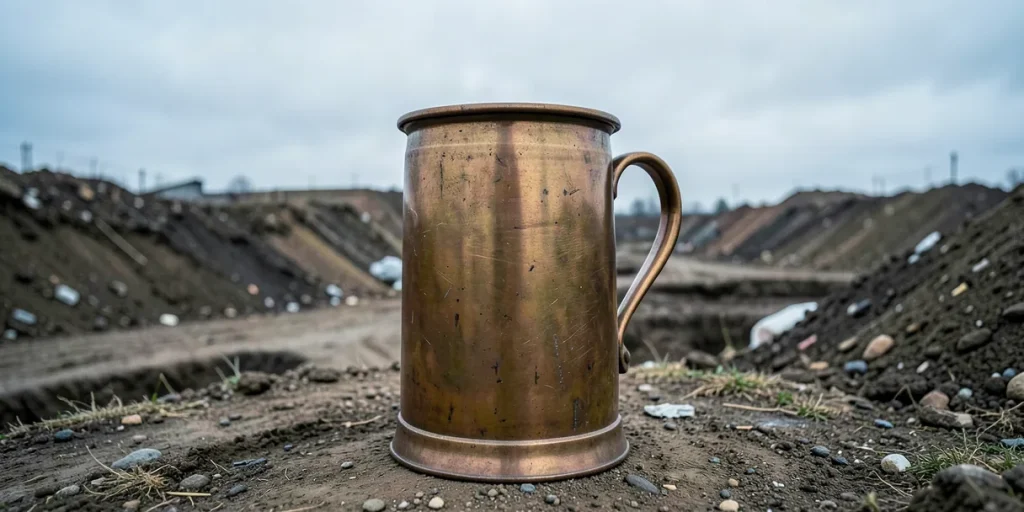
Nearly four liters of liquid in a bronze vessel — that is how the find from a Qin-era tomb in China’s Ningxia Hui Autonomous Region is usually described. But retellings of the story have conflated different dates and conclusions: the age of the vessel and tomb is not the same as a precisely established age for the drink, and residues in the vessel do not necessarily justify calling it beer in the modern sense.
The more reliable account is less dramatic and more interesting: archaeologists found a bronze vessel with organic residues that researchers linked to a fermented grain drink. Reports about the discovery mention millet and a volume of around four liters. Without the full laboratory paper, it is impossible to confidently reconstruct the recipe, alcohol content or exact composition. So below, the find itself, the analytical methods and what remains conjecture are considered separately.
- About 4 L — the reported volume of liquid in the vessel, not the proven capacity of a standard bottle or the amount of drink preserved.
- More than 2,300 years — the commonly cited estimate for the age of the find’s context; the precise dating of the residues should be checked against the excavation report.
- Qin era — the period assigned to the tomb in descriptions of the find; the Qin dynasty ruled from 221 to 206 BCE.
Historical context of the discovery
The find is associated with a bronze vessel from a tomb in China’s Ningxia Hui Autonomous Region. Popular reports call it “nearly four liters of ancient beer” and date it to more than 2,300 years ago. This should not be read as the result of directly measuring the liquid’s age: archaeologists usually date a burial by its construction, objects and associated finds, and place the vessel in the historical context of the tomb.
The word “beer” itself also matters. To a modern reader, it means a drink made from malted grain, water, yeast and often hops. Ancient fermented drinks could have been made differently, including from millet and other grains; the term in a news headline does not guarantee that the recipe fully matched that of beer today. To establish the precise dates of the vessel and its contents, the field report and laboratory paper by the archaeologists would need to be checked.
Chinese societies used grain-based drinks long before the Qin Empire. Finds from the Neolithic settlement of Jiahu in Henan Province date to around 7000–5600 BCE; analysis of organic residues in vessels revealed signs of a fermented drink made from rice, honey and fruit. This is a different site, a different period and a different composition. Jiahu provides evidence of early fermentation, but by itself does not prove that millet beer was brewed there.
To claim that a particular vessel was used for an offering or ritual, evidence is needed about where it was found and how the tomb was arranged. A burial context makes ritual use possible, but does not establish it automatically.
Ancient brewing technologies
If millet was indeed identified in the residues, that points to the use of a local grain, but does not reveal the sequence of production. Fermentation requires available sugars and microorganisms; the grain might have been sprouted, boiled or processed in a way that converted starch into sugars. Without published markers, none of these possibilities can be selected as the exact recipe.
It is useful here to distinguish three levels of inference. Grain particles or chemical markers may indicate raw ingredients; signs of fermentation may indicate a process; but claims about flavor, alcohol content and serving method require additional evidence that is absent from brief reports about the find. Even the discovery of carbohydrates and proteins does not, by itself, prove that the contents were an alcoholic drink: these substances occur in many foods.
Comparing this drink with modern lager is not appropriate. The recipe for an ancient fermented grain drink may have lacked hops and purified yeast cultures, and its method of converting starch to sugar may have differed from industrial mashing. Only the components identified and described using a stated method in laboratory research can be considered reliably known.
The vessel’s material does not guarantee that its contents were fully preserved, either. Bronze may have protected the contents from external contamination if the vessel was sealed and the burial conditions were suitable, but organic compounds break down over time and interact with metal. “Airtight” is a characteristic that should be confirmed by the condition of the lid and the excavation report, not inferred simply from the fact that the vessel was found intact.
Brewing in ancient China
Grain-based alcoholic drinks existed in China in different eras, but the word “beer” here covers technologies that may have differed substantially. Millet was an important raw material in northern regions; elsewhere, people used rice and other grains. During the Shang period, dated to around 1600–1046 BCE, bronze ritual vessels and inscriptions attest to the importance of libations and alcoholic drinks at court and in ceremonies. This does not mean that every drink was millet beer.
Traditional Chinese production of grain-based drinks often relied on qu, a starter culture in which molds, yeasts and other microorganisms develop. It helps break down starch and initiate fermentation. This technology should not be attributed to the vessel from Ningxia without analysis: archaeological residues must confirm which microorganisms and raw materials were used there.
Neolithic vessels from Jiahu and bronze ware from the Qin era answer different questions. The former attest to early fermented drinks; the latter show how alcohol was placed among grave goods thousands of years later. Neither example describes the entire diet of ancient China or the habits of every social group.
To understand who the drink belonged to and how it was consumed, archaeologists need to know where the vessel was placed in the tomb, what objects were nearby and whether there were any inscriptions. One container is not enough to generalize about everyday consumption.
Archaeological research methods
Archaeologists first document the context: where the vessel stood, whether it was sealed, what was nearby and how the burial was arranged. This information is often more important than a striking figure for volume. Ground-penetrating radar can indeed help survey the soil before excavation, but discovering the contents usually requires careful opening and laboratory work; the claim that ground-penetrating radar found this vessel needs confirmation in the report.
Organic residues are studied using several methods. Gas chromatography and mass spectrometry separate mixtures and help identify chemical compounds; microscopy can reveal grain particles and starch granules. Radiocarbon analysis is used to determine the age of organic material, if there is enough and it is well enough preserved. The age of a tomb, the date of charcoal and the date of a liquid are different measurements and cannot be substituted for one another.
Even a positive laboratory result requires checks for contamination. Modern substances may have entered the vessel during excavation, storage or sampling; metal and soil can also affect its chemical composition. That is why control soil samples, a description of conservation and a list of the markers found are important. Without these details, it is impossible to independently assess how confidently the residues have been identified as beer.
Preservation does not mean that the drink remained safe to consume or retained its original flavor. For archaeologists, molecular traces and context are valuable, not the possibility of tasting the contents.
Comparison with other cultures
The Chinese find can be compared with Mesopotamia in terms of raw materials and the role of grain-based drinks, but not on the basis of the word “beer” alone. In southern Mesopotamia in the third millennium BCE, barley was an important crop, and cuneiform administrative documents recorded beer rations for workers. These are direct records of economic accounting; they do not prove that the drink was similar in taste or production to the Chinese one.
Beer was also part of the diet and supply system in Egypt. Images of brewing and written records help researchers study production, while the vessel from the Chinese tomb provides primarily archaeological and chemical evidence. The difference in sources matters: the frequency of consumption cannot be compared using a single burial find and documents recording the distribution of rations.
| Region and example | Period | What the sources confirm | Limitations of the comparison |
|---|---|---|---|
| China, Jiahu | About 7000–5600 BCE | Residues of a fermented drink made from rice, honey and fruit | This is not proof of millet beer |
| Mesopotamia | Third millennium BCE | Cuneiform documents and economic records concerning grain beer | Written records do not reveal the complete recipe |
| China, the Ningxia find | Context assigned to the Qin era, 221–206 BCE | Bronze vessel and reported organic residues | The precise composition should be checked against the laboratory paper |
In each region, grain was processed according to local crops, climate and customs. A sound comparison therefore begins with specific archaeological and written evidence, not the assumption that beer played the same role everywhere.
Modern research and findings
The main value of this find is the opportunity to test what was in the vessel and how it was used. The news phrase “ancient beer found” compresses a chain of reasoning: first, archaeologists describe the context; then a laboratory analyzes the residues; after that, the authors compare the chemical data with known products. The level of confidence can vary at each stage.
To update what is known, researchers need more than repeated retellings: they need a publication naming the researchers and institution, describing the analytical methods and listing the compounds identified. These details are not included in the original report. It is therefore not possible to responsibly state the exact alcohol percentage, full recipe, laboratory date for the liquid or proven function of the drink.
Experiments by modern brewers using ancient recipes can test whether a similar product can be made from millet and a starter culture. But a reconstruction does not prove that ancient brewers made the drink in exactly this way: they may have used different grain varieties, water, microorganisms and equipment. The results of such brewing should be labeled experimental archaeology, not a recreation of the original.
The next verifiable step is to compare the publication about the vessel with excavation materials and the laboratory protocol. Until those details are available in the account of the find, “four liters” describes the reported vessel, not the established alcohol content or precise composition of the drink.
Cultural heritage and brewing traditions
The bronze vessel from the burial is valuable for more than its drink residues. It connects an object, a rite and the material culture of the Qin era, but its specific meaning depends on the archaeological context. It cannot automatically be concluded that the drink symbolized fertility or unity: such interpretations require comparison with texts, inscriptions and other finds.
Modern beer culture in China is a separate subject. The country is home to major producers, including China Resources Beer, Tsingtao Brewery and Beijing Yanjing Brewery; their modern products are not a direct continuation of the recipe from the ancient bronze vessel. Millennia of changes in ingredients, technology and consumer habits separate the archaeological evidence from today’s market.
Nor should beer be assigned the same place at every Chinese celebration. What is served depends on the region, family and occasion, and the study of a single tomb does not describe modern customs. If you are interested in a specific tradition or the craft beer market, you need separate data for the region and period, not a generalization based on an archaeological find.
The future of ancient beer research
New research may clarify the raw materials, fermentation method and dating if suitable samples and excavation records have been preserved. This requires independent laboratory measurements, control soil samples and publication of the methods. Radiocarbon analysis can date suitable organic material, but it does not always provide the precise date of the drink itself; the result depends on what exactly was submitted for analysis.
International comparisons are useful when researchers compare the same types of data: grain markers with grain markers, for example, or supply records with supply records. Comparing a Chinese vessel, Sumerian tablets and Egyptian images can show the diversity of practices, but cannot establish a single line of origin for beer.
To trace the history of this particular find, check three things in the scientific publication: the exact excavation location, the basis for the dating and the chemical compounds used to identify the residues as a fermented grain drink. Until this information is available, conclusions about the recipe and ritual use remain open.
Frequently asked questions
Where was the vessel with drink residues found?
The find is associated with a Qin-era tomb in China’s Ningxia Hui Autonomous Region. The exact location and circumstances should be checked against the excavation report.
Is the beer really more than 2,300 years old?
This estimate is often given for the find. It may refer to the burial context; the precise age of the organic residues requires separate evidence.
What was the drink made from?
Reports mention millet. The full recipe and list of ingredients cannot be established without published results of chemical analysis.
Can the contents be considered modern beer?
Not necessarily. An ancient fermented grain drink may have differed in its method of converting starch to sugar, its starter culture and its composition; the brief description gives no information about hops or alcohol content.
What does the find prove?
It points to the presence of a grain-based drink in a Qin-era burial context. Further finds and documents are needed to draw conclusions about everyday consumption or a specific ritual.
Key takeaways
- The find is associated with a bronze vessel from a Qin-era tomb in Ningxia; the reported volume is about four liters.
- Millet is mentioned as a possible raw material, but the exact recipe cannot be reconstructed from the brief description.
- The age of the tomb and the age of its contents are different questions; the dating method and laboratory data matter.
- Jiahu, Mesopotamia and Egypt offer useful comparisons, but their evidence concerns different drinks and sources.
Sources
To verify the dating and composition, the primary publication on the excavation in Ningxia and the laboratory report on the analysis of the organic residues are needed. The comparison with early Chinese drinks draws on a study of vessel residues from Jiahu, published in the journal Proceedings of the National Academy of Sciences in 2004; the general chronology of the Qin dynasty is based on academic reference works. Brief news retellings are no substitute for this evidence.