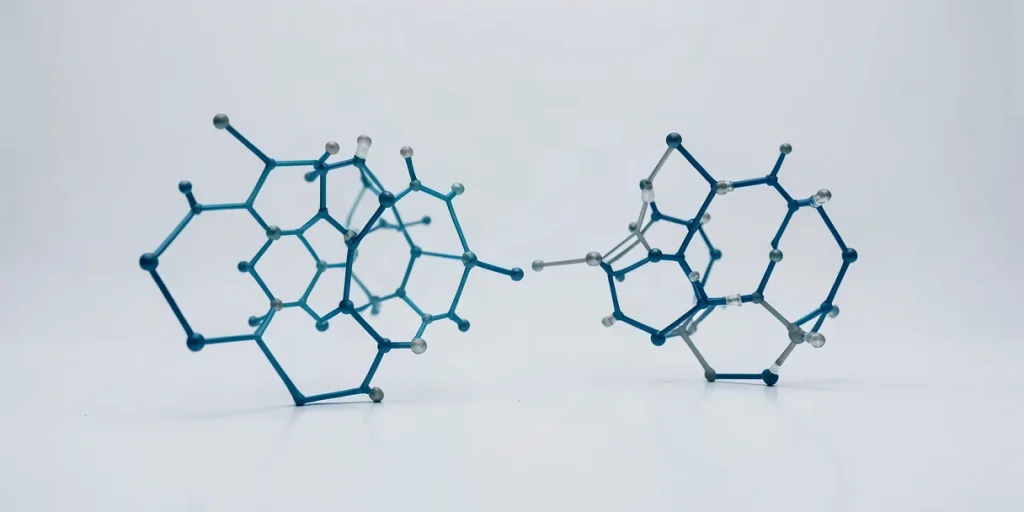
The 2026 Nobel Prize in Chemistry was awarded to Henri B. Kagan and Kenso Soai for their research on nonlinear effects and autocatalysis in asymmetric organic synthesis. Their work helped explain how homochirality—the predominance of one of two mirror-image forms of molecules—can arise. The prize is worth 12 million Swedish kronor and will be shared equally between the laureates.
The mystery of mirror-image molecules
Some molecules exist in two forms related like left and right hands: their mirror-image structures cannot be superimposed by simply rotating one of them. In living organisms, proteins are built from only one of the two varieties of amino acid. This preference for one form is called homochirality.
The chemical mystery was how this imbalance arises. Experiments with reactions capable of producing both mirror-image forms typically yielded them in equal proportions. Understanding the mechanism behind this selection matters not only for explaining natural processes, but also for synthesizing molecules designed to interact with living organisms.
Henri Kagan’s breakthrough
The first decisive step in the research came from Henri Kagan: in 1986, he discovered a way to control a chemical reaction so that one mirror-image form was produced in a significantly greater excess than had previously been thought possible. His work showed that the outcome of asymmetric synthesis did not have to be equal for the two molecular forms.
For chemists developing pharmaceuticals, this difference has practical significance. Molecules with the same composition but different mirror-image structures can interact differently with living systems; one form may be needed, while the other may be useless or dangerous. Controlling which form is produced is therefore one of the key challenges in developing medicinal compounds.
Soai’s experiments
Kenso Soai continued the research into nonlinear effects and autocatalysis. In 1995, he published a paper on the first chemical reaction capable of leading to homochirality. Autocatalysis means that a reaction’s product helps accelerate its own formation; combined with asymmetry, this process can amplify an initial predominance of one form.
In 2003, Soai presented a reaction that produced only one of the two possible mirror-image forms. Until then, only nature had achieved this kind of result. The sequence of studies—from controlling an excess of one form to a reaction with a single mirror-image product—marked the path from a laboratory effect to an explanation of how asymmetry can amplify itself.
Implications for drug synthesis
The laureates’ discoveries give chemists a basis for understanding how homochirality can arise spontaneously. This connects a fundamental question about the origin of molecular selectivity with practical synthesis: when producing pharmaceuticals, it is important to obtain the desired mirror-image form rather than a mixture containing equal amounts of each variant.
Heiner Linke, chair of the Nobel Committee for Chemistry, called the reactions developed “spectacular” and linked Kagan and Soai’s discoveries to solving a mystery more than a century old. The 12 million Swedish kronor prize will be shared equally. Kagan was born in France in 1930, and Soai in Japan in 1950; both are professors emeritus.
Announcement of the prize
The Chemistry laureates were announced on Wednesday, October 7, 2026, no earlier than 11:45 CEST, corresponding to 12:45 Moscow time. The announcement is part of the 2026 Nobel Prize schedule, which spans several days in October.
The schedule also lists literature on October 6, the Peace Prize on October 9, and the Prize in Economic Sciences on October 12. The published schedule lists literature again for October 8. The central outcome of the Chemistry Prize was recognition of research linking autocatalysis to the emergence of an excess of one mirror-image form of molecules.
Key takeaway: Kagan and Soai’s work explained how an autocatalytic reaction can amplify molecular asymmetry, which is important in nature and pharmaceutical synthesis.
Sources
- elar.urfu.ru — “NON-EQUILIBRIUM PHENOMENA IN CHEMISTRY”
- portal.tpu.ru — “WINNERS OF THE RFBR 2013 COMPETITION”
- booksite.ru — “1 Molecular Biology of the Cell”
- philpapers.org — “[PDF] high hume (biopower and biopolitics in a risk society)”
