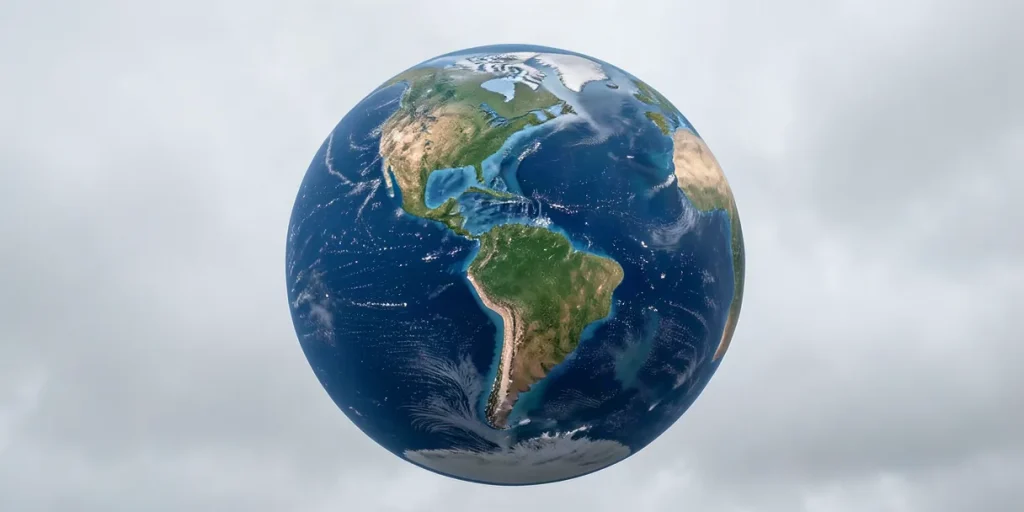
Changes in Earth’s Shape: Key Research Facts
Geologist Christopher Kotsakis from Aristotle University of Thessaloniki published a study in the Journal of Geophysical Research: Solid Earth confirming changes in Earth’s shape driven by internal geophysical processes. According to his work, over the last two decades the uplift rate of polar regions has doubled, significantly impacting the planet’s global form.
These changes are linked to mass redistribution on Earth’s surface caused notably by ice melting in the Arctic and Antarctic, as well as mantle shifts and tectonic activity. These processes result in Earth becoming simultaneously less flattened while the polar areas rise upwards.
Glacial Isostatic Adjustment and Its Consequences
Glacial isostatic adjustment is the process whereby Earth’s crust responds to changes in loading following the end of the last Ice Age about 11,000 years ago. In areas once covered by thick ice sheets, the crust gradually uplifts to compensate for the loss of ice mass.
In Greenland and Antarctica, where intense ice melt has been observed over recent decades, the crust is rising at an increasing rate. According to Kotsakis, this uplift reached about 1 millimeter per year by 2015, whereas in the late 1990s it was around 0.5 millimeters per year. At the same time, meltwater adds weight to the ocean floor, causing it to subside.
Satellite Observation Data and Its Role
Satellite data from the Global Navigation Satellite System (GNSS) played a key role in confirming Earth’s shape changes by recording vertical movements of the ground from 1997 to 2015. These data enabled measurement of the accelerated uplift of polar regions and subsidence of equatorial areas.
Analysis showed the polar uplift rate doubled in less than 20 years. Similarly, equatorial zones are experiencing enhanced subsidence. These processes significantly affect Earth’s global geometry and require ongoing consideration in geodesy and climatology.
The Impact of Tectonic Processes on Earth’s Shape
Besides glacial changes, internal geophysical dynamics such as mantle shifts and tectonic activity also influence Earth’s shape. Mass redistribution inside the planet causes crustal deformation and alters its flattening.
Research indicates these combined processes reduce Earth’s solid flattening even as polar uplift accelerates. This points to a complex interaction dynamic between surface and internal factors governing the planet’s shape.
Significance for Science and Practice
Changes in Earth’s shape have important implications for geodesy, navigation, and understanding climate change. The acceleration of polar uplift alongside equatorial subsidence affects mass distribution and sea levels, which must be accounted for in long-term planning.
Kotsakis’ findings will improve modeling of Earth’s crustal change processes, crucial for advancing satellite navigation technologies and natural phenomena monitoring. They also open new avenues for studying the planet’s internal dynamics.
Summary: Earth’s shape is changing due to ice melt and geophysical processes, accelerating polar uplift and reducing planetary flattening.