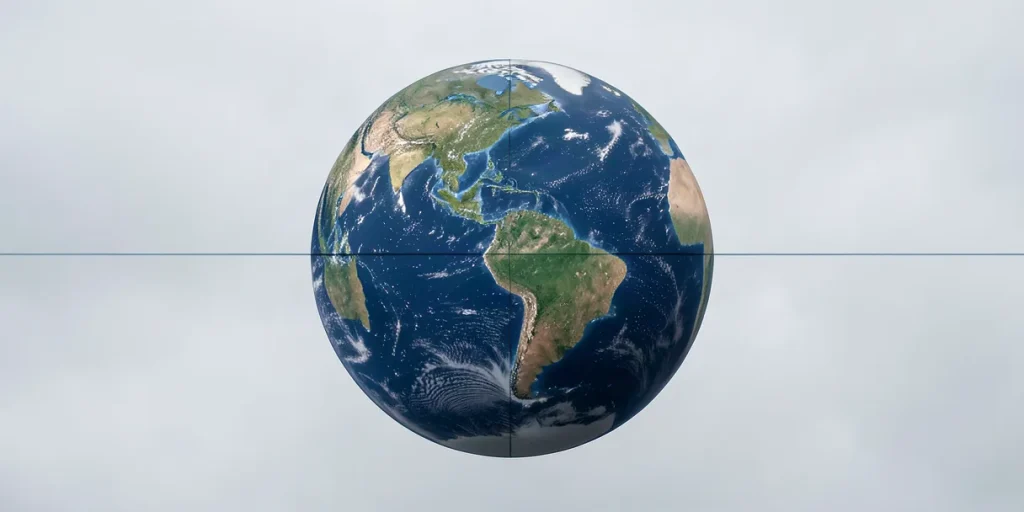
Changes in Earth’s Shape: Key Facts
Geologist Christopher Kotsakis from Aristotle University of Thessaloniki published an important study in the Journal of Geophysical Research: Solid Earth, demonstrating that Earth’s shape is changing at an accelerating rate. Specifically, the uplift speed of polar regions has doubled over the past 20 years, indicating significant geophysical processes affecting the planet’s solid surface.
These changes are linked to the redistribution of mass on Earth’s surface: melting ice in the Arctic and Antarctic reduces pressure on the crust, causing it to rise, while meltwater adds weight to the oceans, especially near the equator, leading to subsidence of the seafloor and a decrease in Earth’s flattening.
Mechanisms and Causes of Earth’s Shape Changes
The uplift and subsidence of the crust are caused by glacial isostatic adjustment — a process where Earth’s crust responds to changes in mass resulting from glacier melting that began after the last Ice Age about 11,000 years ago. Ice is melting particularly rapidly in Greenland and Antarctica, substantially affecting crust dynamics.
The removal of massive ice sheets reduces pressure on the crust, causing uplift at a rate that reached 1 mm per year in polar regions by 2015, double the rates of the late 1990s. At the same time, meltwater increases ocean mass, causing seafloor subsidence in near-equatorial areas.
Satellite Observation Data and Their Significance
Kotsakis analyzed data from the Global Navigation Satellite System (GNSS) spanning 1997 to 2015. This data enables tracking vertical surface movements at the millimeter scale, providing precise insight into changes in Earth’s shape.
The study showed that polar uplift accelerated from 0.5 mm per year in the late 1990s to 1 mm per year by 2015. Meanwhile, the equatorial zone experiences increasing subsidence. These interconnected processes reduce Earth’s flattening, making its shape less ellipsoidal.
Impact on Geophysics and Climatology
The accelerating changes in Earth’s shape have important implications for understanding planetary dynamics and global climate processes. Crustal uplift in polar regions affects mass distribution, which can influence Earth’s gravitational balance and sea levels.
Additionally, mass redistribution and changes in Earth’s shape affect navigation systems and require adjustments in geodesy, which are crucial for accurate positioning and infrastructure planning.
Prospects for Further Research
Ongoing monitoring and analysis of GNSS and other geophysical measurements are essential for a more precise understanding of the pace and scale of Earth’s shape changes. Research teams worldwide, including Aristotle University and international geophysical organizations, plan to expand monitoring using new technologies.
Advances in modeling glacial isostatic adjustment and accounting for climate change impacts are expected to improve forecasts of future changes in Earth’s shape and their effects on the environment and human activity.
Conclusion: Earth’s shape is changing at an accelerating pace due to ice melt and mass redistribution, necessitating continuous monitoring and consideration in geophysical and climate studies.