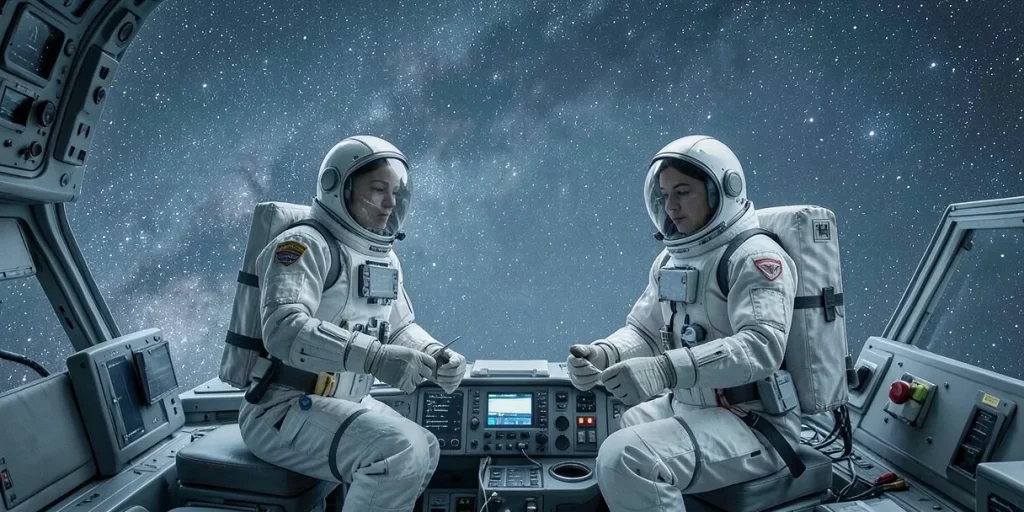
Historic Spacewalk
On August 26, 2026, a crew of two female astronauts carried out, for the first time in history, assembly and technical operations during a spacewalk outside the International Space Station (ISS). Cosmonauts Elena Vasilyeva and Marina Kuznetsova spent more than six hours in Orlan-M spacesuits, successfully installing a new module and replacing equipment. This event marks a significant breakthrough in expanding the role of women in space operations.
The spacewalk was organized by Roscosmos in cooperation with NASA and ESA. For the first time, technical tasks of this level were performed exclusively by a female crew, highlighting the advancement of gender diversity in space exploration and the expansion of professional opportunities for women astronauts.
Technical Details and Mission Tasks
During the spacewalk, assembly work was carried out to connect the new scientific module “Nauka-2,” weighing approximately 400 kg, as well as replacing elements of the life support system. Elena Vasilyeva was responsible for welding operations using specialized Russian-made equipment, while Marina Kuznetsova handled the inspection and connection of cable lines that provide power and communications.
The use of modern Orlan-M spacesuits ensured the crew’s mobility and safety even while performing complex technical tasks. The duration of the spacewalk was 6 hours and 15 minutes, which is consistent with the average time for similar operations, but unprecedented for a crew of this composition.
Crew Preparation and Training
Preparation for the spacewalk lasted more than nine months and included training in the hydro-laboratory at the Yuri A. Gagarin Cosmonaut Training Center in Star City. The training focused on practicing welding and assembly methods in microgravity conditions, as well as coordinating actions within an all-female crew.
Special attention was given to adapting to spacesuits and technical equipment designed specifically for female physiology. This improved work efficiency and reduced risks associated with prolonged exposure to the open space environment. Simulators featured equipment models from RKK Energia and NPO Mashinostroyenia.
The Role of International Cooperation
The successful completion of these assembly tasks was the result of close cooperation between Roscosmos, NASA, and the European Space Agency (ESA). Engineers from the US and Europe provided real-time support and consulting on integrating the new equipment with ISS systems.
This joint effort ensured a high level of safety and technical reliability for the operation. Plans are underway to expand women’s participation in similar missions going forward, building on the successful experience of 2026 and strengthening international partnerships in space exploration.
Impact on the Future of Space Exploration
The successful all-female spacewalk and assembly work open new prospects for increasing gender balance in space missions. According to Roscosmos experts, this experience will help raise the proportion of female astronauts involved in technically complex operations from the current 15% to 30% within the next five years.
Moreover, this milestone encourages the development of specialized equipment and spacesuits adapted to diverse physiological characteristics, enhancing overall efficiency and safety in space operations. Looking ahead, such advancements will support more ambitious projects, including lunar stations and missions to Mars.
Conclusion: The first-ever spacewalk conducted exclusively by a female crew represents a vital step toward equality and innovation in space exploration.
Sources
- astronaut.ru — “Repairs in Orbit”
- sdelanounas.ru — “Inside Out: How Cosmonauts Prepare for Spacewalks in the Blog ‘With Our Own Eyes’ / Made in Russia”
- interfax.ru — “Taikonauts Completed Six-Hour Spacewalk”
- sgvavia.ru — “Cosmonaut Alexei Leonov’s First Step into the Abyss”
- gctc.ru — “Again First: Soyuz MS-19 Spacecraft with Russian Crew”