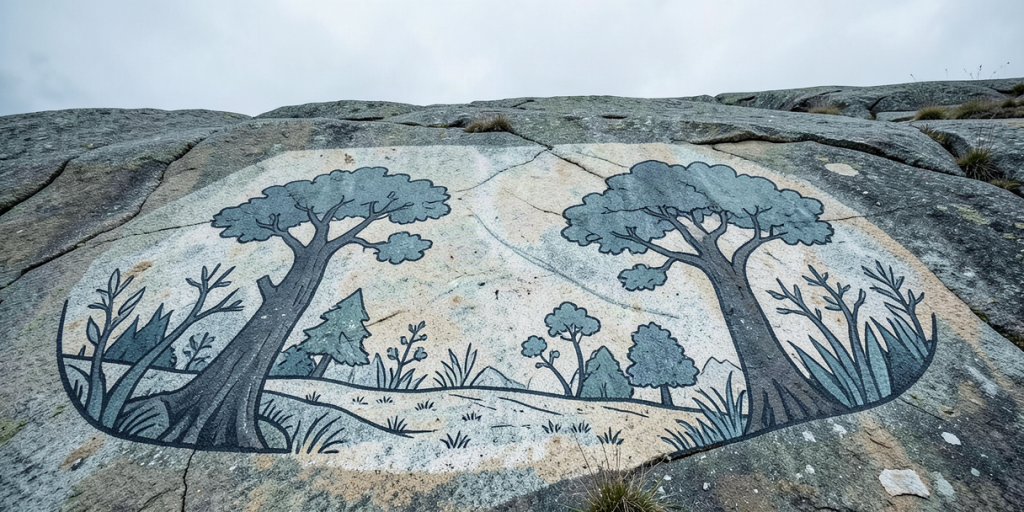
Recent studies have revealed an astonishing property of human blood: it can protect rock art from destruction. Scientific experiments have shown that blood components possess unique protective properties that help preserve ancient images on rocks in pristine condition for centuries. This unexpected fact is intriguing not only to scientists but also to art and history enthusiasts.
Given that many rock paintings are exposed to natural factors and human activities, protecting them from destruction has become a major task for researchers. The discovery about the properties of blood could lead to new methods of conservation and restoration of cultural heritage, as well as deepen our understanding of the interaction between humans and nature over millennia.
Introduction to Rock Art
Rock art represents unique artworks created by ancient cultures on the surfaces of stones and cliffs. These images, often made using natural pigments, reflect not only the artistic abilities of their creators but also serve as important evidence of their way of life, beliefs, and surrounding world. They are a vital part of humanity’s cultural heritage and allow modern researchers to glimpse into the past by studying the social, spiritual, and ecological aspects of life thousands of years ago.
Historically, rock art emerged in various eras and in diverse corners of the world. The earliest examples date back tens of thousands of years and can be found on all continents, including Europe, Africa, Australia, and America. Each culture employed its unique style and technique, depicting animals, humans, hunting scenes, and ritual activities in their images. These artworks served not only as a means of self-expression but also fulfilled functions of communication and knowledge transfer between generations.
The geographical distribution of rock art around the world attests to the diversity of cultures and traditions. In Europe, the famous Lascaux and Altamira caves attract the attention of researchers and tourists, while in Australia and China, rock art also has deep roots and represents important elements of local culture. For example, in Australia, Aboriginal rock paintings play a significant role in the culture of the Indigenous peoples, while in China, rock images found in places like Huashan testify to a rich artistic heritage.
Recent studies dedicated to the preservation of these artworks have revealed that human blood, used as a binding agent in ancient times, has remarkable properties that protect rock paintings from destruction. This discovery highlights not only the technological achievements of ancient peoples but also the importance of preserving cultural heritage, which continues to inspire and amaze modern society.
New Discoveries in Art Preservation
Researchers continue to amaze the world with new discoveries in the field of art preservation, and recent studies have confirmed the unique protective properties of human blood. During the analysis of rock paintings found in various regions, including Australia and China, it was discovered that blood was used as a binding agent in antiquity, ensuring the longevity and preservation of these artworks. This finding not only sheds light on the methods our ancestors used but also opens new horizons for cultural heritage preservation.
Studies have shown that human blood mixed with colored pigments served as an effective binding agent that ensured the adhesion of the paintings to the rock surface. Examples of rock paintings that are over 4,200 years old demonstrate the use of this material in ancient rituals and artistic practices. In particular, in China, archaeologists have found fragments containing both human and animal blood, indicating the multifaceted approaches to creating art.
Moreover, the analysis of Australian rock images, in which blood was also discovered, underscores the global nature of this material’s application. Researchers suggest that blood may not only have served as a binding agent but also held symbolic significance, strengthening the bond between the artist and their creation. This approach to using blood as a component of art emphasizes the importance of cultural and spiritual aspects in the lives of ancient peoples.
Thus, the new discovery about the protective properties of human blood opens up numerous opportunities for researchers to study and preserve rock art. It not only allows for a deeper understanding of the methods employed by ancient artists but also raises questions about how modern technologies can aid in the preservation and restoration of these unique works.
Scientific Research Methods
As part of the study of rock paintings, various scientific analysis methods have been applied by researchers, allowing them to obtain new data about the technology used in their creation and longevity. The primary method utilized was spectroscopy, which helps determine the chemical composition of pigments and binding agents. This revealed that human blood was used as a binding medium in certain rock paintings, which had not been previously assumed. The analysis of samples from different regions, such as Australia and China, confirmed that this material not only retains pigments but also protects them from the destructive effects of the environment.
Modern technologies play a key role in archaeology. For example, the application of radiocarbon dating and three-dimensional scanning has enabled scientists to accurately determine the age of rock paintings and visualize their details without physical interference. This is especially important for preserving unique cultural heritages. Using technologies such as X-ray fluorescence, researchers have been able to analyze the microstructure of samples, allowing for a more detailed examination of the layering process and their interactions.
Comparisons with other materials used to create rock paintings have also confirmed the uniqueness of human blood as a binding agent. Unlike traditional natural dyes such as charcoal or ochre, blood possesses specific properties that provide better adhesion and protection against moisture and sunlight. This discovery emphasizes the importance of studying ancient technologies and materials, as understanding their properties can aid in developing new methods for conserving and restoring historical monuments.
Thus, the use of modern scientific methods in conjunction with traditional archaeological approaches has opened new horizons in the study of rock paintings and has become an important step in their preservation for future generations.
Blood as a Binding Agent
Blood, as a binding agent, represents a unique material that was used by ancient artists to create rock paintings. The chemical composition of human blood includes proteins, lipids, carbohydrates, and minerals, making it an excellent binding medium. These components contribute to forming a durable bond between pigments and the rock surface, ensuring the longevity and protection of the artworks from external environmental influences.
The advantages of using blood over synthetic materials are evident. Firstly, blood is a natural and environmentally friendly product, reducing negative impacts on the environment. Secondly, its use as a binding agent helps preserve the unique properties of pigments that might be lost when using chemical additives. Additionally, blood has antimicrobial properties, protecting the paintings from damage caused by microorganisms and mold.
Historical evidence of the use of blood in art can be found in various cultures and regions. For example, studies of rock paintings in Australia and China confirmed that ancient peoples used both human and animal blood as a binding medium. In some cases, the age of such artworks reaches over 4,200 years, highlighting the durability and effectiveness of this method. The use of blood in art was not limited to rock paintings; in some traditions, it was used to create paints and other artistic materials.
Thus, the discovery that human blood served to protect rock paintings underscores not only its importance in the context of preserving cultural heritage but also the unique properties that make it an indispensable component in the history of art.
Global Significance of the Findings
The global significance of the findings
The recent discovery that human blood was used as a binding agent to protect rock paintings significantly expands our understanding of ancient cultures. This finding challenges traditional notions about the materials used by our ancestors to create art and emphasizes the importance of human involvement in preserving cultural heritage. The use of blood as a binding agent may indicate deep ritualistic and symbolic meanings associated with the processes of art creation. Such findings can help researchers better understand the social and cultural contexts in which these works were created, as well as their role in the lives of ancient communities.
Moreover, this discovery opens new horizons for future research in other regions. Scholars may begin to investigate rock paintings in various parts of the world to identify similar practices. This could not only enrich our knowledge of the diversity of artistic expression but also lead to important conclusions about the migration and interaction of different cultures. Research in this area may also reveal how various societies adapted to their surrounding conditions, using available resources to create sustainable art.
Ethical and cultural aspects of using biological materials in scientific research also raise important questions. On one hand, such studies may contribute to the preservation of cultural heritage, while on the other, they may call into question moral norms associated with the use of human remains. This raises questions about how we should treat biological materials that were part of the lives of ancient peoples. It is essential to approach these aspects carefully to respect the memory of those whose lives and cultures formed the basis of our understanding of history.
Thus, the discovery about the protection of rock paintings by human blood not only adds valuable information to our historical database but also opens new directions for research, fostering a deeper understanding of ancient cultures and their heritage.
Preservation and Restoration of Rock Art
The preservation of rock paintings represents an important task for modern society, as they are not only a valuable cultural heritage but also a unique window into humanity’s past. In recent years, scientists and heritage preservation specialists have actively begun to employ various methods to protect and restore these ancient works of art. One interesting discovery has been the use of human blood as a binding agent, which has helped to understand how ancient peoples preserved their creations.
Today, a variety of methods are used to preserve rock paintings. These include chemical and mechanical techniques, such as applying special protective coatings that prevent destructive environmental effects. Technologies such as 3D modeling and photogrammetry are also utilized to document the condition of the paintings, allowing for monitoring changes and planning restoration work. In some cases, natural materials are used, helping to preserve the original appearance of the works and minimize negative impacts on their structure.
The role of the public in preserving cultural heritage is also difficult to overestimate. Educational programs, exhibitions, and lectures help raise awareness about the importance of protecting rock paintings. The necessity of involving local residents and volunteers in restoration projects is becoming increasingly relevant, as they can become not only defenders but also custodians of traditions. Examples of successful initiatives show that communities actively participating in the preservation of their cultural heritage can achieve significant results.
One prominent example of successful restoration of rock paintings is the projects in Australia and China, where both modern technologies and traditional methods were employed. In these countries, scientists were able not only to conduct restorations but also to create platforms for further study and protection of rock art. This approach ensures that future generations will be able to enjoy and learn from these unique testimonies of human history.
The Future of Research
The future of research in archaeology, particularly in the context of preserving rock paintings, is gaining new perspectives thanks to recent discoveries about the role of human blood as a binding agent. This finding not only deepens our understanding of ancient technologies but also opens new horizons for exploring the methods used by our ancestors. Researchers may focus on analyzing various biological materials that were used in the past for creating and preserving art.
Firstly, it is important to investigate the influence of various natural substances, such as animal blood, plant extracts, and minerals, on the longevity and resilience of rock paintings. This could lead to the identification of new techniques that could be adapted for modern restoration methods. For example, the use of eco-friendly and biodegradable binding agents could become an important step in preserving cultural heritage in line with contemporary environmental protection standards.
New technologies, such as 3D scanning and spectroscopic analysis, may also change the approach to art preservation. These methods allow for a detailed examination of the composition of pigments and binding agents, as well as assessing the degree of their degradation. As a result, archaeologists and restorers will be able to develop more effective strategies for protecting and restoring ancient artworks.
Promising research directions may include:
- Comparative analysis of various binding agents used in different historical periods.
- Investigating the influence of climatic conditions on the preservation of rock paintings.
- Developing new technologies for non-invasive diagnostics of the condition of ancient artifacts.
- Studying the impact of modern pollutants on ancient materials.
Thus, the discovery of the role of human blood in protecting rock paintings not only deepens knowledge of ancient cultures but also emphasizes the importance of an interdisciplinary approach in archaeology, which combines technology, biology, and art history. This discovery could serve as the foundation for new methods of preservation and restoration that will help safeguard cultural heritage for future generations.
Conclusion
Conclusion
The discovery of the protective role of human blood in safeguarding rock paintings represents a significant contribution to the study of cultural heritage. This research not only sheds light on the ancient technologies used by our ancestors but also emphasizes the importance of preserving unique artifacts that are witnesses to human history and culture. Understanding how materials such as human blood were used in the past can help us better protect and preserve these artistic creations for future generations.
An interdisciplinary approach to heritage study, combining archaeology, chemistry, and art history, can unveil new aspects in the exploration of rock art. The combination of knowledge from various fields allows for a deeper understanding of the methods and materials employed by ancient artists, as well as the development of effective strategies for their preservation. This discovery may serve as the foundation for broader research in the field of cultural heritage preservation, which is particularly relevant in the face of contemporary threats such as climate change and environmental pollution.
It is important for society to recognize the value of cultural heritage and the need for its preservation. Raising awareness about such research can stimulate interest in history and culture, as well as contribute to funding heritage conservation programs. We must remember that each generation bears the responsibility for preserving the heritage left to us by our ancestors. The preservation of rock paintings and other cultural objects not only enriches our understanding of the past but also creates a bridge between generations, allowing us to better realize our identity and place in the world.
Thus, this discovery not only emphasizes scientific significance but also serves as a call to action for all of us — to cherish and protect the cultural heritage that forms the foundation of our shared human experience.
Frequently Asked Questions
How was blood discovered in rock paintings?
Why is human blood better than other materials for preserving art?
Where else have rock paintings using blood been found?
How can one participate in the preservation of rock paintings?
Key Takeaways
- Human blood was used as a binding agent in rock paintings.
- Scientific research opens new horizons in cultural heritage preservation.
- Ethical aspects of using biological materials have become an important topic for discussion.
Sources
RD Magazine, naked-science.ru, prospect.com.ru, mir24.tv, science-start.ru