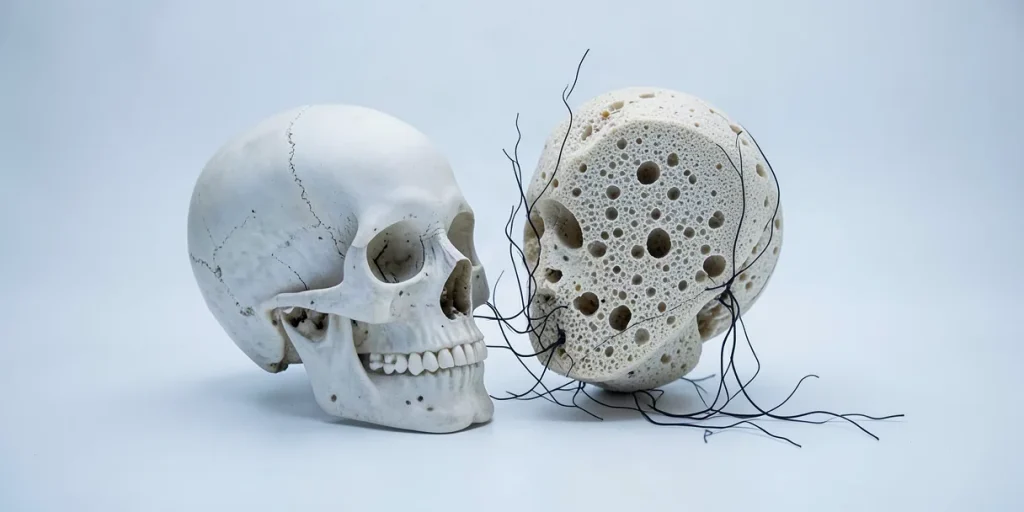
Scientists at the N. V. Sklifosovsky Research Institute for Emergency Medicine have developed a bone implant to replace defects in the skull vault. On October 3, 2026, Rospatent head Yuri Zubov announced the development in an interview with RIA Novosti. The implant can be infused with substances that accelerate cell growth and blood vessel development, which is expected to support the implant’s integration with surrounding tissue.
What injuries the implant is designed for
The implant is intended to cover areas where the bone of the skull vault has been damaged. This is the purpose stated in the announcement about the work by scientists at the Sklifosovsky Institute; no specific causes of the defects or list of suitable patients were provided.
This is a bone-replacement device, not a universal remedy for every type of head injury. The published description does not specify the size of defects the implant is suitable for or the circumstances in which doctors might choose it over other reconstructive options.
What sets the implant apart
Its key feature is the ability to infuse the material with substances intended to accelerate cell growth and blood vessel formation. These processes are important for the implant’s interaction with tissue; the developers say they can improve integration.
The announcement does not identify the material or the substances to be infused, how they are delivered, or how long they remain active. For now, it is therefore possible to describe the principle behind the development, but not to assess its specific composition, application protocol, or comparative effectiveness relative to other implants.
What is known about the development and registration
Yuri Zubov, head of Rospatent, announced the device in an interview with RIA Novosti on October 3, 2026. The N. V. Sklifosovsky Research Institute for Emergency Medicine is named as the developer. The information provided does not mention other project participants, testing stages, or manufacturing details.
The brief description also says that registration was successfully completed. However, it does not specify what registration procedure is meant, when it was completed, or what documents or permits were issued. These details are important for understanding at what stage the device may be used in medical practice.
What cannot yet be concluded
The announcement confirms the implant’s intended use and describes a mechanism designed to support integration, but it does not include clinical trial results. It provides no figures on the number of patients treated, recovery times, or complication rates, so the published information does not support conclusions about effectiveness or safety.
There is also no information about the implant’s availability to hospitals, its cost, or when it may come into use. These factors matter to doctors and patients just as much as the design itself: the device’s practical value will depend on how it is used and what results it achieves in treating skull vault defects.
Key takeaway: The Sklifosovsky Institute’s development is designed to replace defects in the skull vault; its distinguishing feature is the ability to infuse substances that stimulate cell and blood vessel growth.
Sources
- ria.ru — “Russia develops unique bone implant — RIA Novosti, 03.10.2026”
- tvc.ru — “An implant for patients with skull injuries”
- patents.google.com — “Implant for skull bone replacement and method”
- fnkc-fmba.ru — “Cranioplasty: cost, stages of surgery, preparation”
- medline.ru — “A new method for preparing the skull vault bones for”
