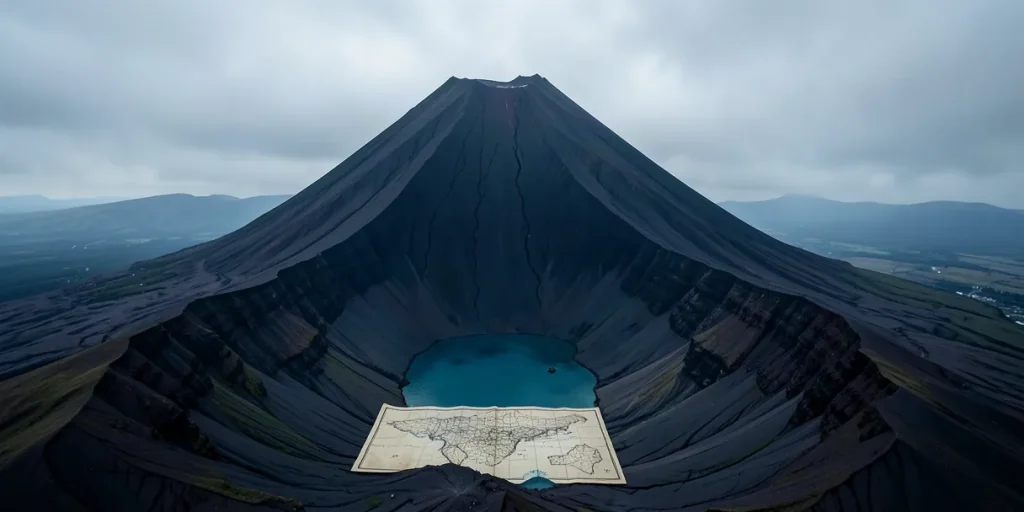
Journey to the Center of the Earth is an adventure novel by Jules Verne about an attempt to reach the planet’s depths. The heroes’ journey becomes an exploration of a mysterious underground world, where scientific curiosity goes hand in hand with danger and a fantastical plot prompts reflection on the limits of human knowledge.
The novel captivates readers with more than its unusual route: it shows how ideas about the Earth and the desire to discover the unknown drive an adventure. To see how this plot resonates with other depictions of pushing beyond human limits, also read our review, “The Quest for Immortality: Scientific Pursuits, Myths, and Cultural Images.”
| Element | In the novel | Status |
|---|---|---|
| Snæfellsjökull | Entrance to the depths | Real volcano |
| Stromboli | Exit from the underground world | Real volcano |
| Underground sea | Part of the heroes’ route | Fantastical premise |
| Ichthyosaurus and plesiosaurus | Inhabitants of the underground world | Fantastical episode |
- 2 volcanoes Snæfellsjökull and Stromboli mark the entrance and exit on the novel’s route
- 2 travelers Otto Lidenbrock and Axel form the central pair of heroes
- 2 species Ichthyosaurus and plesiosaurus are named among the prehistoric animals of the underground world
How does Jules Verne’s journey to the center of the Earth begin?
The journey to the center of the Earth begins when Professor Otto Lidenbrock deciphers a manuscript found in an old book and decides to follow its instructions. He sets off with his nephew Axel: the deciphered text becomes the starting point for their underground adventure.
From Iceland to Stromboli
The travelers choose the crater of Iceland’s Snæfellsjökull volcano as their entrance to the depths. The route that began with a manuscript thus becomes a journey through an underground world: the heroes descend into the Earth from a volcanic crater.
The underground route leads to Stromboli, another volcano that serves as an exit to the surface. Snæfellsjökull and Stromboli provide the two landmarks for the journey: the heroes enter the depths through the first and leave them through the second.
What do the heroes encounter underground?
An underground sea and ancient life
Underground, the heroes in Jules Verne’s novel encounter an underground sea, an enormous cavern with its own horizon, and prehistoric animals. On the shore of this sea, Axel and his companions watch an ichthyosaurus and a plesiosaurus—two ancient inhabitants whose fight turns the underground world into a place of real danger.
The underground sea and cavern bring different trials: the expanse of water becomes part of the journey, while Axel’s separation from the others is a distinct turning point. Left without his companions, he tries to find his way and locate water; the search for water is not an incidental adventure but a necessity for continuing the journey.
The heroes do not find a passage out of the depths: a force of nature gets them out, as a volcanic eruption hurls them to the surface. The journey is therefore shaped by three memorable encounters—with the underground sea, ancient animals, and an eruption—while the search for water and Axel’s separation from the others show how easily the expedition can teeter on the brink of disaster.
Which scientific ideas of the era are reflected in the novel?
Journey to the Center of the Earth reflects the 19th century’s interest in the structure of the Earth’s interior: Jules Verne combines an adventure plot with geology, volcanoes, and paleontology. Ideas about the Earth’s internal structure were still developing at the time, and the author turns this scientific quest into the driving force of the journey, rather than mere background for the adventure.
Snæfellsjökull in Iceland and Stromboli in Sicily are real volcanoes that Verne incorporates into a fictional route. This blend of recognizable geography and an imaginary journey connects the scientific interests of the era with the novel’s imagined world; its geological and paleontological themes make the depths a place where adventure goes hand in hand with an attempt to understand the Earth’s past.
For a broader look at scientific pursuits and cultural images of immortality, read our article “The Quest for Immortality: Scientific Pursuits, Myths, and Cultural Images.”
Why is a literal journey to the center of the Earth impossible?
Where geology ends and fantasy begins
A literal journey to the center of the Earth is impossible: the planet is not hollow but made up of layers, where pressure and temperature increase with depth. The air-filled caves through which the heroes of Jules Verne’s novel might travel downward are therefore incompatible with conditions in the Earth’s interior.
- Earth’s layers: The interior is described as a sequence of layers, not a single void that can be explored.
- Depth: Pressure and temperature increase, so an air-filled space suitable for people to spend time in cannot serve as a route to the center.
- Volcanic crater: It is not a vertical tunnel through the planet; volcanoes are associated with localized geological processes.
The underground sea and the prehistoric reptiles living freely in it belong to the novel’s fantastical world, not to any verified account of the Earth’s interior. Comparing these images with the planet’s structure reveals the boundary between Jules Verne’s adventurous premise and geological reality: a crater does not lead to the center, and the underground environment does not form an inhabitable ocean.
Where does Jules Verne’s novel fall short of modern geology?
Jules Verne’s novel falls short of modern geology by turning real geological features into elements of a fantastical route: a volcano becomes an entrance and an exit, while the Earth’s interior becomes an inhabited world with a sea and ancient animals. Scientific terminology and recognizable volcanoes make the story convincing in its details, but do not make a journey through the Earth realistic.
In geology, a volcano is not a tunnel running through the planet: its conduit is connected to a magmatic system and offers no safe route into the deep interior. The volcanic entrance and exit in the novel therefore work as a plot device, not a possible route. An underground sea and an extensive cavern are also inconsistent with the modern model of the Earth’s structure: the planet’s interior is not an open space filled with air.
What real discoveries tell us about the Earth’s past
In the novel, ancient animals share a world that travelers can enter, but paleontological discoveries do not support this idea: fossils are found in rocks, not in an accessible underground ecosystem. Real volcanoes and rock names lend the setting a sense of recognition, but in themselves they do not prove that the entire route is geologically plausible.
What in the novel should be read as science, and what as fiction?
Snæfellsjökull and Stromboli are real geographical landmarks in Jules Verne’s novel, while the passage between them through the depths of the planet is fiction. Geology gives the narrative a recognizable foundation, but does not confirm either an underground sea or an extensive cavern inhabited by prehistoric creatures.
The book’s strength lies in the contrast between specific names on a map and a bold hypothesis turned into an adventure. Snæfellsjökull and Stromboli exist in the real world; the route connecting them inside the Earth belongs to the logic of the novel, not to a geological description of the planet.
Three levels of authenticity
- Verified feature: Snæfellsjökull and Stromboli are real geographical names.
- Scientific idea of the era: Ideas about the Earth’s internal structure that may have served as a starting point for the author’s imagination.
- Plot device: A journey underground between these landmarks, an underground sea, and prehistoric creatures.
This distinction makes it possible to read the novel both as an adventure and as a literary play on scientific ideas. Real places anchor the imagination, but they do not turn a fantastical route into a verified geological fact.
Frequently Asked Questions
Who sets off on the journey to the center of the Earth?
Which volcano do the heroes enter the depths through?
Do the heroes leave through the same volcano?
Is there a sea beneath the Earth like the one in Verne’s novel?
Key Takeaways
- Verne’s route begins at Snæfellsjökull and ends at Stromboli.
- Otto Lidenbrock and Axel are the novel’s main travelers.
- The underground sea and prehistoric reptiles are fictional.
- The real volcanoes in the novel do not make a journey to the center of the Earth geologically possible.
