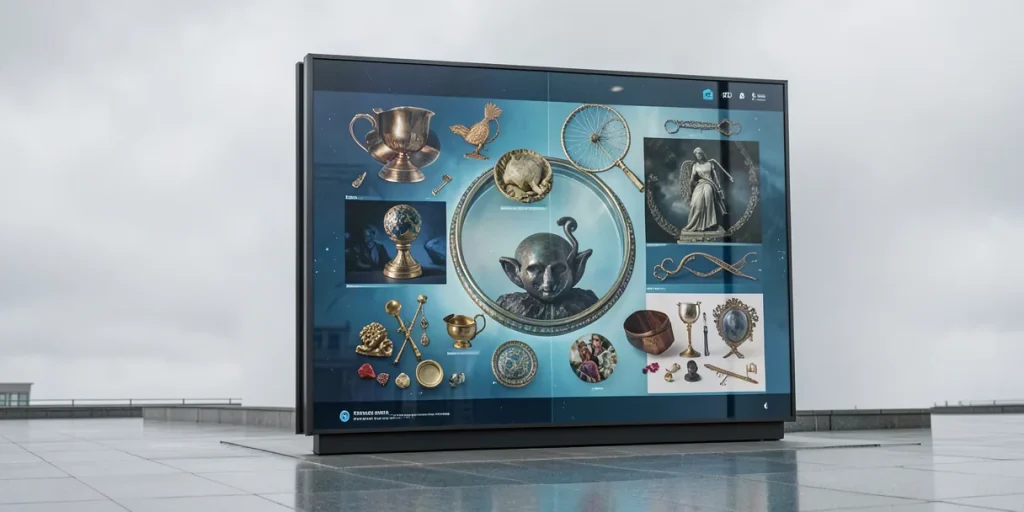
Contemporary museums actively utilize digital technologies such as interactive screens, augmented reality, and mobile applications to make visits more engaging and accessible to diverse audiences. These innovations help visitors dive deeper into exhibits and participate in interactive educational programs.
In the digital age, museums are no longer mere repositories of artifacts but dynamic spaces where technology plays a key role in attracting and retaining visitor attention. The use of modern digital tools not only expands the boundaries of the traditional museum experience but also makes it more personalized and interactive.
In this article, we explore how modern museums are integrating digital technologies to engage audiences and why this trend is becoming a vital element of culture and education in 2026.
| Technology | Example of Use | Equipment Cost | Year Introduced |
|---|---|---|---|
| Augmented Reality (AR) | Pushkin Museum, Magic Leap | from 1 million ₽ per project | 2025 |
| Virtual Reality (VR) | Hermitage, Oculus Quest 3 | from 1.5 million ₽ | 2026 |
| Interactive Panels | Tretyakov Gallery, Samsung Flip 2 | about 200,000 ₽ per panel | 2024 |
| Haptic Navigation | Pushkin State Museum of Fine Arts, Estimote | about 500,000 ₽ | 2025 |
| AR Audio Guides | Museums of the Russian Federation, “Museum 360” app | free or up to 500 ₽ per use | 2024 |
- 78% of visitors retain information better after VR exhibits
- 15-20% increase in museum attendance with AR audio guides
- 500,000 ₽ average cost of equipment for haptic navigation
- 40% of museums limited in digitalization due to budget and technical issues
- 500 million ₽ funding from the Russian Ministry of Culture for museum digitalization in 2026
Which Digital Technologies Are Most Commonly Used in Museums to Attract Visitors?
AR and VR in Museums
Augmented and virtual reality technologies occupy a central role in modern museums for attracting visitors, offering a unique interactive experience. For example, since 2025, the Pushkin Museum has employed an AR solution from Magic Leap that allows viewing 1:1 scale reconstructions of historical objects. Since 2026, the Hermitage has operated a VR zone with Oculus Quest 3 headsets where visitors can virtually stroll through halls closed to the public.
Interactive Panels and Mobile Applications
Interactive touch panels Samsung Flip 2, installed in the Tretyakov Gallery since 2024, cost about 200,000 rubles each and immerse visitors in exhibits through multimedia content. Additionally, the “Museum 360” mobile app, developed by the National Research University Higher School of Economics, enables AR audio guides directly on smartphones, expanding opportunities for independent exploration of exhibits.
- Magic Leap AR — 1:1 scale, implemented since 2025 at the Pushkin Museum;
- VR zone with Oculus Quest 3 — since 2026 at the Hermitage;
- Samsung Flip 2 — interactive panels priced around 200,000 rubles, installed since 2024 at the Tretyakov Gallery;
- “Museum 360” mobile app — AR audio guides developed by the Higher School of Economics.
How Do Digital Solutions Affect the Educational Experience of Museum Visitors?
Improved Learning Efficiency
Digital solutions significantly enhance visitors’ retention and comprehension of information. A 2026 study by the Institute of Cultural Studies of the Russian Academy of Sciences found that 78% of participants using VR exhibits remembered the material 30% better compared to traditional viewing of artifacts. Technologies like virtual reality and 3D modeling create more visual and interactive educational environments, aiding deeper knowledge acquisition. The cost to develop a single VR exhibit ranges from 1.5 to 3 million rubles depending on project complexity, reflecting investments in quality and innovation.
Increased Engagement and Attention Retention
Interactive digital technologies greatly increase visitors’ time spent and interest. At the Experimentanium Science Museum, the introduction of interactive stands raised average visit duration from 25 to 40 minutes, indicating greater audience engagement. Moreover, the use of AR audio guides boosts museum attendance by 15–20%, especially among young people, according to the Russian Ministry of Culture (2026).
- VR exhibits: 30% increase in information retention
- Average visit duration with interactive stands – 40 minutes
- VR project development cost – 1.5 to 3 million rubles
- Attendance growth with AR audio guides – 15–20%
Which Modern Digital Solutions Help Museums Improve Accessibility for Visitors with Disabilities?
Haptic and Audio Technologies
Modern digital solutions like haptic navigation systems and VR with audio descriptions significantly enhance museum accessibility for visitors with disabilities. At the Pushkin State Museum of Fine Arts, a navigation system based on Estimote Bluetooth beacons integrated with a mobile app helps visually impaired visitors orient themselves in the space. The installation cost of such a system averages 500,000 rubles, including software development and equipment setup.
Since 2025, the Russian Museum has operated a «VR for the Visually Impaired» program using HTC Vive Pro Eye headsets. These devices feature specialized audio descriptions of exhibits, enabling visitors with visual impairments to fully experience exhibitions through multimodal content interaction.
Compliance with National Standards
The introduction of digital technologies in museums adheres to GOST R 57678-2021, which requires ensuring multimodal access to information. This standard is already implemented in 12 Russian museums, guaranteeing support for various perception methods for visitors with special needs.
- Estimote Bluetooth beacons — foundation of haptic navigation at the Pushkin Museum;
- Haptic navigation equipment cost — about 500,000 rubles per museum;
- HTC Vive Pro Eye headsets — key element of the VR program for the visually impaired at the Russian Museum;
- GOST R 57678-2021 — standard ensuring multimodal access, implemented in 12 Russian museums.
When Are Digital Technologies Ineffective in Museums and What Limitations Exist?
Technical and Financial Barriers
Digital technologies in museums often prove ineffective due to high equipment costs and technical constraints, especially in architectural monuments. A 2026 survey of Moscow museum staff revealed that 40% cited equipment costs and annual maintenance exceeding 1 million rubles as significant limitations to scaling digital solutions. For example, installing heavy VR devices in the Winter Palace is impossible due to strict preservation requirements and technical restrictions.
Additionally, frequent technical failures and a shortage of qualified personnel negatively affect service quality: in 25% of cases, the use of interactive technologies results in a diminished visitor experience. This necessitates extra spending on staff training and equipment maintenance, complicating effective use of digital tools in some museums.
User Preferences
Not all visitors are ready to embrace digital technologies as a positive addition to museums. About 15% prefer the traditional format, noting that digital solutions distract from direct contact with original artifacts. This is especially evident in collections where emotional and visual connections to historical objects are important.
- Digital system maintenance costs: from 1 million rubles per year
- Restrictions on VR equipment installation in the Winter Palace
- Reduced service quality in 25% of cases due to technical issues and staff shortages
- 15% of visitors prefer traditional museum formats without digital technologies
What Are the Prospects for Digital Technologies in Russian Museums by 2030?
Artificial Intelligence and Holography
By 2030, more than half of museums in major Russian cities plan to implement artificial intelligence technologies to create personalized tour programs, significantly enhancing visitor engagement. Leading museums are preparing to use holographic exhibits based on Light Field technology, expected to be deployed by 2028. The cost of a single holographic installation starts at 2 million rubles, reflecting the high technological complexity and innovation.
- Over 50% of large urban museums to integrate AI for customized tours;
- Light Field holographic exhibits to be introduced starting 2028;
- Cost of one holographic installation — from 2 million rubles.
Government Support and Infrastructure
In 2026, the Ministry of Culture of the Russian Federation allocated 500 million rubles to digitalize museum exhibits in the regions, promoting the development of modern technologies in cultural institutions outside the capitals. Concurrently, active use of 5G networks is anticipated to transmit large volumes of data in real time, significantly improving the quality of virtual and augmented reality used in museum projects.
- 500 million rubles funding for regional museum digitalization in 2026;
- Growth in 5G network use for AR/VR solutions in museums;
- Improved quality of interactive services via high-speed data transmission.
Frequently Asked Questions
What is augmented reality (AR) in the museum context?
How much does it cost to install an interactive panel in a museum?
How do digital technologies assist people with disabilities?
Why don’t all museums actively adopt digital technologies?
Key Takeaways
- AR and VR technologies make museum exhibits more interactive and memorable
- Interactive panels and mobile apps increase visitor engagement
- Digital solutions improve museum accessibility for people with health limitations
- High costs and technical restrictions slow mass technology adoption
- Government support promotes digitalization of regional museums