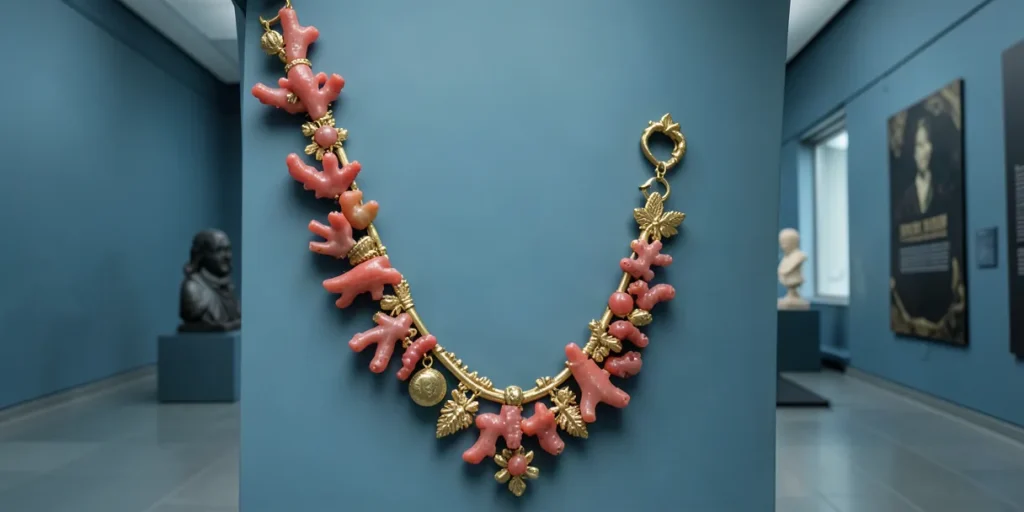
Theft in the Heart of Vienna
At 10:15 p.m. local time on August 27, 2026, a major robbery took place at the Vienna Museum of History. A unique necklace known as the “Coral Necklace” was stolen. It belonged to Egypt’s 18th Dynasty and is believed to have belonged to Queen Hatshepsut. As of June 2026, the piece, made of 24-karat gold and rare Red Sea coral, was valued at more than $4.3 million. It is one of the most expensive thefts in the history of Austrian museums.
The necklace was on display as part of the temporary exhibition “Treasures of Ancient Egypt,” which ran from July 15 to September 30, 2026, and was organized in partnership with the Egyptian Museum in Cairo.
The Necklace’s Historical Value
Made around 1450 BCE, the “Coral Necklace” is an outstanding example of ancient Egyptian jewelry-making from the New Kingdom period. It consists of 78 coral beads and 15 gold elements inlaid with lapis lazuli and turquoise. Such jewelry was worn exclusively by high-ranking members of the royal family, as confirmed by finds in Theban tombs, including the tomb of Tutankhamun.
Its production was overseen by the priestly class, underscoring the necklace’s uniqueness and sacred significance.
Reactions from Authorities and the Public
As soon as the theft was discovered, Vienna police launched a wide-ranging investigation involving forensic specialists and international agencies, including Interpol and Europol. A reward of $500,000 was announced for information leading to the criminals’ arrest and the necklace’s recovery. According to Austria’s Interior Ministry, rewards of this kind increase the likelihood of solving crimes by 30–40%.
The news of the theft sparked widespread public concern. Local authorities promised to review security standards at cultural institutions within the next two months.
Museum Security Concerns
The incident at the Vienna Museum of History once again draws attention to security problems affecting exhibits around the world. Of these, 40% are linked to inadequate security and outdated video surveillance systems.
Major museums such as the Louvre in Paris and the British Museum in London have already invested more than 25 million euros in upgrading their security systems between 2023 and 2026. New measures include biometric access control, smart motion sensors, and integrated systems for analyzing visitor behavior.
Vienna plans to introduce similar solutions during 2027, including 360-degree cameras with 8K resolution and a temperature and humidity monitoring system. These measures will help prevent theft and preserve the exhibits.
Possible Consequences of the Theft
The theft of the “Coral Necklace” has serious implications for both the Vienna Museum of History and the global cultural community.
There is also a high likelihood that the necklace will end up on the antiquities black market, where the price of objects like it could reach $10–15 million, given their uniqueness and historical significance. International organizations, including UNESCO and Interpol, have already stepped up efforts to monitor the illegal trade in artifacts.
Recovering the necklace will be a priority for international law enforcement cooperation and a signal that global efforts to protect cultural heritage must be strengthened. The case is a reminder of the need for a systematic approach to preserving history and art for future generations.