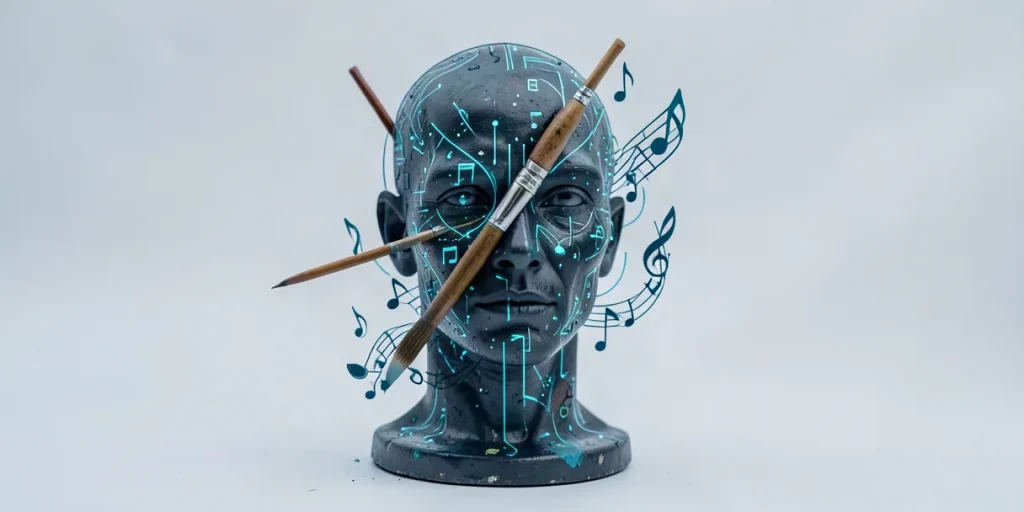
Introduction: The Essence of AI’s Impact on Creative Professions
Artificial intelligence (AI) in 2026 has become a powerful tool transforming the landscape of creative professions. Today, over 40% of companies in the design and media sectors use AI to automate part of their creative tasks. This opens new opportunities for artists, musicians, and writers, but also raises concerns about job losses and questions of authorship. We will explore how this transformation is unfolding and what consequences it brings.
Automation and Expansion of Creative Potential
AI in creativity serves less as a human replacement and more as a means to expand capabilities. Systems like OpenAI GPT-4 and Midjourney enable the creation of texts, images, and musical compositions with minimal human involvement.
Examples of Tools and Their Applications
- OpenAI GPT-4 – generating literary texts, scripts, and marketing content;
- Midjourney – creating artistic images from descriptions;
- DALL·E 3 – visualizing concepts and illustrations;
- Amper Music – automatic composition of music tracks;
- Adobe Firefly – integrating AI into professional graphic editors.
The average subscription cost for professional AI tools ranges from $15 to $50 per month, making them accessible to a broad range of creators.
Impact on Productivity and Quality
Using AI reduces the time to create prototypes and concepts by 30–50%, allowing specialists to focus on unique aspects. For example, in advertising, automatic idea generation with GPT-4 can save up to 20 working hours per project.
Risks to Employment and Professional Identity
Despite the benefits, AI poses threats to traditional creative professions. According to 2025 research in the US, about 15% of creative jobs may be automated within the next five years.
Threats and Challenges
- Job reduction – especially in routine design and content generation roles;
- Authorship issues – difficulty determining rights for AI-assisted works;
- Ethical questions – use of other artists’ data and styles without permission;
- Loss of uniqueness – standardization of creative products due to algorithmic generation.
In Russia in 2026, amendments to copyright law regulating AI use in creativity are already under discussion, reflecting the seriousness of the issue.
New Professions and Directions in Creativity
The rise of AI stimulates the development of new careers related to managing and optimizing creative processes.
Key New Specialties
- AI Content Curator – quality and ethical oversight of automatically generated works;
- AI Interaction Designer – creating interfaces and scenarios for creative AI systems;
- Generative Design Specialist – developing algorithms for creative tasks;
- Consultant on AI Work Rights – legal support for new forms of authorship.
The average salary for these professions in Russia ranges from 80,000 to 150,000 rubles per month, which is competitive with traditional creative roles.
Comparative Analysis of Traditional and AI-Assisted Creative Processes
| Parameter | Traditional Process | AI-Assisted Process |
|---|---|---|
| Creation Time | From several days to months | From several hours to days |
| Average Cost | from 50,000 to 200,000 ₽ per project | from 10,000 to 60,000 ₽ per project |
| Level of Uniqueness | High, depends on talent | Medium, depends on AI settings |
| Labor Intensity | High | Medium |
| Risk of Copyright Infringement | Low | Medium and above |
Social and Cultural Consequences of AI Implementation
Widespread AI use in creativity is changing public perception of art and cultural values. On one hand, it democratizes creativity — tools become accessible not only to professionals but also amateurs. On the other hand, it raises dilemmas about the human role in art and preserving cultural heritage.
Impact on Culture and Society
- Expanding creative participation through accessible AI solutions;
- Challenges in evaluating artistic value and originality;
- Emergence of new art forms blending human and algorithmic creativity;
- Questions of maintaining authenticity and historical continuity.
In 2026, Russian cultural institutions are beginning to integrate AI into educational programs, signaling recognition of the importance of new technologies.
- 40% of creative sector companies use AI in workflows
- 15% of creative professions are at risk of automation
- 80,000–150,000 ₽ average salary of new AI specialists in creativity
- 30–50% reduction in content creation time with AI assistance
Frequently Asked Questions
How does AI affect copyright in creativity?
Can AI fully replace the creative human?
What professions will emerge thanks to AI in creativity?
How is the labor market changing for creative specialists?
Key Takeaways
- AI significantly boosts productivity and reduces costs in creative professions.
- Serious risks exist for employment and copyright, requiring regulation.
- New professions related to AI use and control in creativity are emerging.
- AI is changing the cultural landscape, expanding participation and creating new art forms.
- A balance is needed between technological progress and preserving the human factor in creativity.
Conclusion
In 2026, artificial intelligence has become an integral part of creative industries, offering unique opportunities as well as serious challenges. To fully leverage AI’s potential and minimize risks, comprehensive cooperation among technologists, creative professionals, lawmakers, and society is essential. Only this way can creativity develop harmoniously in the digital age, preserving its depth, originality, and human soul.
Sources
- probesto.com — “Explore the Impact of Artificial Intelligence on Creative Industries — Probesto RU”
- Semantic Scholar — “The Impact of Artificial Intelligence on the Labor Market”
- cyberleninka.ru — “Risks and Opportunities of Using Artificial Intelligence in the Sociologist Profession – a scientific article on computer and information sciences, free to read”
- Social Innovations and Social Sciences — “The Impact of Artificial Intelligence on the Legal Services Market: Threat to the Lawyer Profession or New Opportunities?”
- cyberleninka.ru — “Artificial Intelligence in Legal Analytics: Opportunities and Risks”