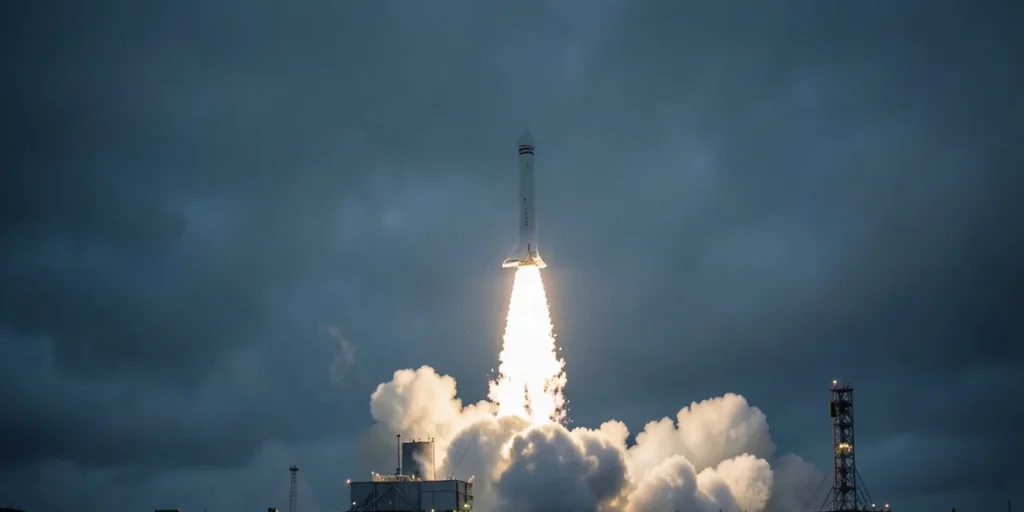
Successful Spectrum Rocket Launch on September 5, 2026
German private space company Isar Aerospace conducted the second test launch of its Spectrum launch vehicle on September 5, 2026, from the Andøya Spaceport in Norway. The launch took place at 22:12 local time and concluded successfully with the rocket reaching orbit about ten minutes after liftoff.
This event marks an important milestone for European private spaceflight, as Isar Aerospace became one of the few companies capable of placing small satellites into orbit from European soil. The launch was meticulously prepared after several delays, underscoring the complexity of modern space technologies.
Technical Specifications of the Spectrum Rocket
The Spectrum rocket is designed to deliver small and medium satellites weighing up to one ton into orbit. The rocket is approximately 30 meters long, with a launch mass exceeding 30 tons. It is equipped with advanced liquid-fueled engines developed in-house, ensuring high efficiency and competitiveness in the market.
Isar Aerospace plans to use Spectrum for commercial launches in the small satellite segment, which is expected to grow significantly by 2030. Launching from Norway’s Andøya Spaceport gives the company stable access to polar orbits and expands the range of services offered.
Andøya Spaceport as a Key Launch Site
The Andøya Spaceport, located on the island of Andøya off Norway’s coast, provides favorable conditions for launching rockets into northern orbits. Its geographic position allows launches with various orbital inclinations, catering to different types of satellites.
The infrastructure at Andøya has been modernized in recent years and is supported by the Norwegian government and private investors. For Isar Aerospace, it is a strategically important site that enables competition with other European operators, such as the French Guiana Space Centre in Kourou.
Impact on the European Space Industry
Isar Aerospace’s success highlights the growing capabilities of Europe’s private space sector, which aims to reduce dependence on foreign technologies and broaden its own expertise. In 2026, the European small satellite market is valued at hundreds of millions of euros, and Spectrum could capture a significant share.
Moreover, the launch strengthens Germany’s position as a hub of aerospace innovation. Government programs supporting the space industry allocate substantial funding to startups, including Isar Aerospace, accelerating technology commercialization.
Isar Aerospace’s Plans and Outlook
Following the successful Spectrum launch, Isar Aerospace plans to carry out a series of commercial missions throughout 2027, targeting clients in Europe and North America. The cost per launch is estimated between 10 and 15 million euros, making the offer competitive in the global market.
The company is also developing more powerful rocket versions and additional services for deploying satellites into various orbits. In the long term, Isar Aerospace aims to become a key player in the small and medium launch segment, supporting the growth of digital and scientific infrastructure.
Conclusion: The successful Spectrum rocket launch from Norway’s Andøya Spaceport represents a major step forward for Isar Aerospace and the entire European private space sector.
Sources
- dw.com — “German Spectrum Rocket Successfully Launched into Space”
- m.ridus.ru — “Isar Aerospace Successfully Placed Rocket into Orbit”
- rfi.fr — “First Rocket Launched from Europe Fell”
- vokrugsveta.ru — “German Spectrum Rocket Reached Orbit”
- russian.cgtn.com — “First Orbital Rocket Launched from”