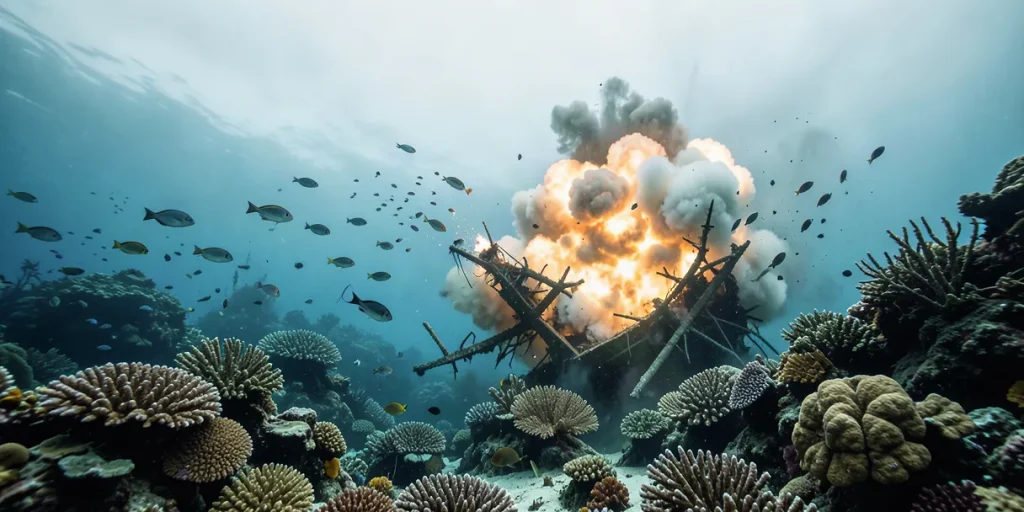
The headline figure of “8,500 bombs” sounds like a confirmed total, but the original publication gives no counting period, location, or organization behind the estimate. It therefore cannot be treated as a verified figure for a recent case or as the scale of blast fishing across Indonesia. It is more reliable to focus on the practice itself: stunning fish with underwater explosions is known to occur in the country and is prohibited by law; the damage is localized but severe for reefs.
Below is an account of what an explosion does to coral and fish, why the practice persists, and which measures can be verified through documentation. Assessing the specific claim of 8,500 explosions requires a primary source, date, and counting methodology.
Introduction to the Problem
Indonesia is part of the Coral Triangle, a center of marine biodiversity in the western Pacific Ocean. Reefs here provide shelter and food for fish and help reduce wave impacts along some stretches of coast. This does not mean that every reef protects the shore equally or that its condition can be assessed using a single figure: depth, reef structure, and coral health all matter.
Blast fishing means stunning or killing fish with an underwater explosion. The shock wave breaks apart the limestone framework of corals and kills or injures nearby organisms. Unlike selective net fishing, an explosion does not distinguish the target fish from juveniles and other species; some of the animals killed may not even be brought in with the catch.
Reefs grow slowly, so physical destruction cannot be quickly remedied simply by banning fishing. Damaged coral colonies lose the structure in which juvenile fish and invertebrates hide. If a reef is repeatedly blasted, pollution, warming waters, and overfishing also hinder recovery.
The claim of “8,500 bombs” requires separate verification: the available text does not name a year, province, observation sample, or official report. Until this information is provided, the figure cannot be used as annual statistics for all of Indonesia.
A Brief Overview of Blast Fishing
Blast fishing uses improvised explosive devices. The shock wave stuns fish within its range, but also damages reefs and kills organisms that are not intended to be caught. This is not “efficient fishing” in the long term: some short-term gains come at the cost of destroying the environment on which future fishing depends.
Why fishers take this risk depends on local conditions. Possible reasons include quick income, limited access to fishing gear and markets, debt, and weak enforcement of the ban. These reasons cannot be attributed to all fishers in Indonesia: understanding a specific community requires interviews, income data, and information about local fisheries.
Indonesia’s Fisheries Law No. 31/2004, amended by Law No. 45/2009, prohibits the use of fishing methods that threaten the sustainability of resources or pollute the environment; explosives are among the prohibited methods. Verifying a specific case requires more than the legal provisions: the arrest report, location, date, evidence, and court outcome are also important.
The ban alone does not show how often violations occur. Comparable data from the coast guard, police, Indonesia’s Ministry of Marine Affairs and Fisheries, and local authorities would be needed. The original report provides no such statistics.
Environmental Consequences
An explosion physically destroys coral colonies: fragments break off and settle on the seabed, while the shock wave can damage tissues and other organisms. Studies of underwater explosions also document the risk of injury to fish, including damage to hearing organs and swim bladders. The specific scale depends on the device’s power, water depth, distance from the reef, and how often explosions occur; without these parameters, the area of damage cannot be calculated.
When complex coral structures disappear, small fish have fewer places to hide and food webs change. This can affect catches, but any decline in fishing yields should not be attributed to a single factor: season, fishing pressure, sea temperature, and the condition of fish stocks also play a role.
Reefs help weaken waves, but the degree of protection depends on their width, depth, and integrity. A damaged area may therefore make the coastline more vulnerable, but claims of a specific increase in erosion or flood damage require local measurements rather than a general estimate.
- No. 31/2004 Indonesia’s Fisheries Law; amended by Law No. 45/2009.
- Coral Triangle The region that encompasses Indonesia’s marine biodiversity; this is a geographical designation, not an assessment of damage.
- 8500 The figure in the original headline; the period and counting method are not specified, so it does not confirm the annual frequency of blast fishing.
Assessing recovery requires separate measurements of live coral cover, the proportion of broken substrate, and fish abundance. A single observation after an explosion does not show whether a reef will recover: the same sites need to be surveyed repeatedly.
Social and Cultural Aspects
Fishing is a source of food and income for coastal communities in Indonesia, but conditions vary widely between islands and villages. A ban on destructive fishing is more likely to work over the long term when people have access to affordable legal gear, buyers for their catch, and a role in managing local waters. Environmental arguments alone are not enough if an alternative fishing method cannot cover a family’s expenses.
Blast fishing creates conflict within communities: some people get a quick catch, while others lose fish and see reef areas damaged. Involving local fishers in patrols and monitoring can improve the detection of violations, but requires clear rules, a safe reporting process, and protection from pressure by offenders.
Training is useful when it is linked to practical skills and markets. Fishers can be taught how permitted gear works and why mesh size or seasonal restrictions affect bycatch and juvenile fish. Specific permitted sizes and seasons depend on the species and regional rules, so they should be checked with the local fisheries authority.
If you read a report about an arrest, check whether it names the village or island, date, agency, and stage of the case. The words “accused” and “caught” do not, by themselves, mean that the accusation has been confirmed in court.
Measures to Address the Problem
The original text claims that new initiatives began in 2026, but names no program, agency, or document. It is therefore not possible to report a specific launch or tougher measures. The verifiable legal basis is Fisheries Law No. 31/2004, as amended by Law No. 45/2009; the current text and applicable penalties should be checked against official Indonesian legal publications.
Enforcement involves patrols, investigating reports, and gathering evidence. In a blast-fishing case, relevant evidence includes devices found, witness statements, the location of the violation, and the accused person’s connection to the prohibited fishing method. A report of an arrest is not a substitute for a court ruling.
Restoring a damaged reef may involve transplanting coral fragments and creating coral nurseries. But planting cannot compensate for repeated explosions: the site must first be protected and the pressures hindering growth removed. Results are assessed by the survival of transplanted corals and the condition of the reef, not by the number of structures installed.
For fishers, it is important to replace destructive methods with legal gear and ensure that they can sell their catch. A project should be assessed using specific indicators: how many participants switched to permitted fishing, whether their incomes changed, and whether violations stopped at the site. The original material names no Indonesian programs or results.
The key stakeholders are Indonesia’s Ministry of Marine Affairs and Fisheries, local authorities, and coastal communities themselves. International organizations may support monitoring and restoration, but each organization’s funding and involvement must be verified for each project.
Examples of Successful Practices
The original publication mentions a “coral garden” in Benin, but provides no project name, location, dates, or results. This example cannot be considered evidence of successful restoration without a primary report. Moreover, Benin is in West Africa, and its coastal conditions differ from those of Indonesia’s islands.
There are marine protected area management and reef conservation programs in the Philippines and Australia, but the mere existence of such programs does not prove that a particular site has recovered. Comparisons require consistent indicators: coral condition before and after intervention, catch volumes, compliance with restrictions, and the monitoring period.
| Approach | What to check | Limitation |
|---|---|---|
| Ban and patrols | Number of confirmed violations, arrests, and court rulings in a specific area | Arrest data depend on patrol intensity |
| Coral nursery and transplantation | Coral survival and site condition in repeat surveys | Does not address the cause of damage if explosions continue |
| Switch to permitted gear | Share of participants, legality of gear, and changes in income | Results depend on market access and the cost of gear |
For Indonesia, the useful approach is to adopt verifiable elements rather than the name of a project elsewhere: joint monitoring, fishing restrictions, sustainable funding, and fishers’ participation in decision-making. Before claiming that a specific project has helped, its report and data covering several years should be found.
Discussion and Conclusions
An underwater explosion catches fish while also destroying the habitat on which future fishing depends. The practice is illegal in Indonesia; its consequences for a particular reef depend on the scale and frequency of the explosions. The claim of 8,500 bombs remains unverified until the year, area, and source of the count are specified.
Assessing the situation requires three types of data: records from specific cases, repeated environmental surveys, and information about local fisheries. These should be sought from Indonesia’s Ministry of Marine Affairs and Fisheries, local authorities, and the authors of the study cited by the publication. Without these data, it is impossible to reliably establish the number of offenders, the area damaged, or the economic losses.
The practical measure of success is simple: explosions stop at the site, the reef is surveyed repeatedly, and fishers can continue fishing legally. If a source provides no such data, it describes the problem but does not prove its scale or the effectiveness of the measures taken.
Frequently Asked Questions
How does blast fishing affect reefs?
The shock wave breaks the coral framework and injures marine animals. The area damaged depends on the strength of the explosion, water depth, and distance; it cannot be determined from a single report without measurements.
Is this kind of fishing banned in Indonesia?
Yes. Indonesia’s Fisheries Law No. 31/2004, amended by Law No. 45/2009, prohibits destructive fishing methods. The specific charge and penalty are determined by the circumstances of the case and the current version of the law.
Is it true that fishers set off 8,500 bombs?
The original material gives no date, location, or report to support this figure. Until the source and counting method are identified, 8,500 cannot be treated as verified statistics.
Key Takeaways
- Underwater explosions damage corals and make it impossible to catch only the target fish.
- Destructive fishing methods are banned in Indonesia under Law No. 31/2004, as amended by Law No. 45/2009.
- The figure of 8,500 cannot be verified without a period, location, and primary source.
- Recovery requires an end to repeated damage and regular reef monitoring.
- The effectiveness of alternative fishing methods should be assessed by legality, reef condition, and participants’ incomes.
Sources
Legal basis: Indonesia’s Fisheries Law No. 31/2004 and Law No. 45/2009 amending it. Verifying the figure of “8,500” requires a primary report with a date, location, and counting methodology; none is cited in the original publication.